Intervention for Struggling ELL Readers
x
1. The Role of Literacy and the Needs of Struggling Learners
First, some hard facts about literacy:
- 37% of students in grade 4, and 26% of students in grade 8 can’t read at a basic level.
- The greatest achievement gaps are among minority groups, with 75% of white students reading at or above basic, compared to 44% of Hispanic and 40% of African American students.
- Similar results exist for students eligible for free or reduced lunches, or students from poverty. (National Assessment of Educational Progress - NAEP)
How do we meet the needs of our struggling learners?
In the Age of the Common Core, meeting the needs of our mainstream readers presents new 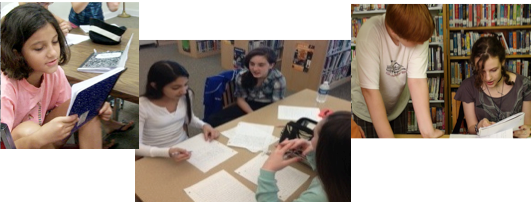 challenges. With new expectations to rise to, the stakes have become even higher for our at-risk learners.
Learning environment, student engagement, learning styles, learning preferences, text readability and readiness for learning are all factors to consider when designing instruction for all learners, as well as for those that struggle. Compton-Lilly (2009) in, “What Can New Literacy Studies Offer to the Teaching of Struggling Readers?” call reading a "social experience" that involves culture and identity, with important roles to play in learning to read. New literacy studies have linked effective literacy practice to lives, identities, and social affiliations (p. 88). With new strategies that move students beyond ordinary literacy tasks to recognition and appreciation of the overall role that literacy experiences play in their learning, the role of social media and new technologies can take center stage in advancing student achievement.
New media has everything to do with it!
Digital print and animation, streaming video, audio, music, sports and constant information feeds are powerful learning forces (Dyson, 2003; Pickering, 2005 In: Compton-Lilly, 2009). Technology has been, and continues to be, a proven method for closing achievement gaps among struggling readers.
Students need daily opportunities to read material at their independent and instructional reading levels to become more fluent readers, and therefore classrooms should have libraries that reflect this need (Ogle, 2010). They need regular opportunities to use academic vocabulary in every day conversations to assimilate and master them, thereby taking greater responsibility for their own learning.
How do we identify effective methods that differentiate for diverse and struggling learners? We remain aware of, and become sensitive to, their cultural backgrounds and learning preferences. We need to select methods that address students learning preferences by responding the following ways:
a) Working one-on-one or in a small groups, allowing students opportunities to coach one another, give feedback, and even mentor.
b) Using humor and emotion in learning through the assignments we give, the outsiders we have in the classroom to present, and the content we share with them. Humor and emotion bring out their "human" side while investing them further in learning through higher engagement.
c) Recognizing achievement. Not through competition either; by recognizing all students, equally. This might require several types of opportunities throughout the year, such as through projects that involve speaking, writing, reporting, interviewing, etc. All students must have an opportunity to shine.
d) Employing and encouraging the use of creativity alongside conformity. Setting rules, giving out instructions, but also allowing them enough room to exercise creative control over their work. Some examples: encouraging student voice in writing, allowing assignments to be accompanied with artwork, and facilitating the ideas students come up with on their own. Making time for them to come up with their own ideas is even better!
e) Creating plenty of activities that involve visual, auditory, or tactile and kinesthetic learning.
f) Provide constant clarification with resources in language and text students understand, as well as through supplemental materials.
g) Allow students opportunities to listen to audio versions of text.
i) Scaffold by combining shared reading with think-alouds, pre-reading activities, guided reading, and post-reading activities.
In this course we’ll continue to examine a number of approaches for differentiation in curriculum design, teaching, and assessments. Each study we review, and source we examine, will share experiences and strategies drawn from work with students in various classrooms of multiple demographics, along with the methods that worked successfully to meet their needs. Keep an open mind as we leverage these strategies in our own classrooms through assignment completion, and then use these new approaches across multiple content areas as we further refine them into expanded lesson ideas.
References:
Compton-Lilly, C. F. (2009). What Can New Literacy Studies Offer to the Teaching of Struggling Readers?. Reading Teacher, 63(1), 88-90.
Proctor, C., Dalton, B., & Grisham, D. L. (2007). Scaffolding English Language Learners and Struggling Readers in a Universal Literacy Environment With Embedded Strategy Instruction and Vocabulary Support. Journal Of Literacy Research, 39(1), 71-93. doi:10.1080/10862960701326530
Ogle, D., & Correa-Kovtun, A. (2010). Supporting English-Language Learners and Struggling Readers in Content Literacy With the "Partner Reading and Content, Too" Routine. Reading Teacher, 63(7), 532-542.
Palumbo, A., & Sanacore, J. (2009). Helping Struggling Middle School Literacy Learners Achieve Success. Clearing House, 82(6), 275-280.
Sanacore, J. (2002). Struggling literacy learners benefit from lifetime literacy efforts. Reading Psychology, 23(2), 67-86. doi:10.1080/027027102760351007