Tiering and Scaffolding
x
1. Scaffolding
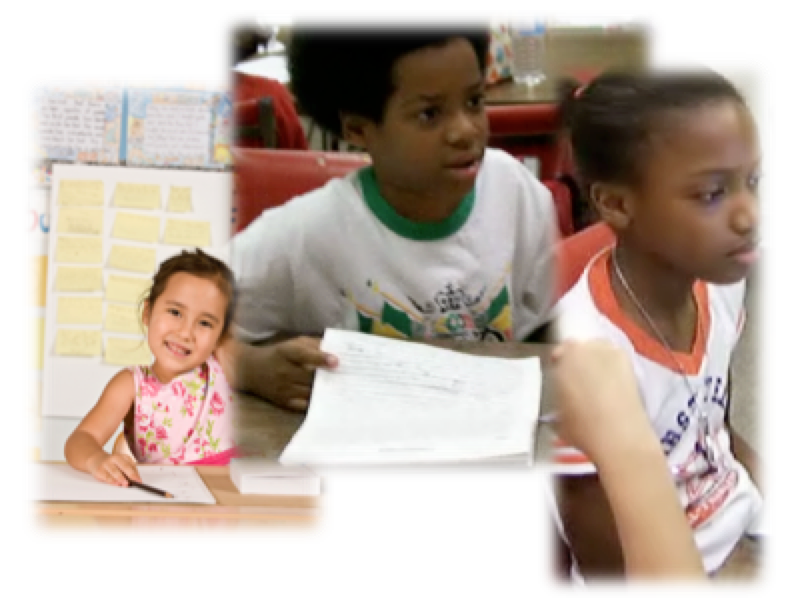
By definition, and in its purest sense, a scaffold is a "temporary structure for holding workers and materials during the erection, repair, or decoration of a building." In K-12 education, scaffolding involves maintaining a steadfast approach in support of a curriculum until a student is ready to be further challenged. It is a gradual release of responsibility to students in increments they can handle pedagogically, and developmentally. It usually begins with a teacher's modeling of a concept or a skill, with the responsibility handed off to students until they can handle all of it independently. This is called building student capacity. This is also based on Bloom's Zone of Proximal Development (Vygotsky, 1978), the gap between what a learner has mastered and what a learner can achieve on his or her own with sufficient support. As students increase their ability, or as the gap closes, teachers decrease the scaffolds until they can do it independently. A thinking map graphic organizer is a good example of this, where one map might include lots of boxes and prompts, the next less, and finally the organizer is removed to allow a student the opportunity to apply the thinking independent of the organizer, holding him or her accountable for the same results.
Use of context clues, brainstorming questions, pre-teaching vocabulary, providing reinforcement through word charts, word walls, and modeling text paraphrasing strategies are among the scaffolding strategies used to get students from Point A to Point B by differentiating (Israel, Maynard & Williamson, 2013).
Due to the abstract nature of some subjects, many students often struggle and under perform for many reasons (Brigham, Scruggs & Mastropieri, 2011 In: Israel, et al., 2013). Some of the challenges for these students include:
- Challenging vocabulary
- Complex, multi-step problems
- Curriculum designed with concepts taught in isolation.
Not surprisingly, about 5% of students with disabilities enter the STEM workforce (Leddy, 2010 in: Israel, 2013). Literacy embedded, evidence-based strategies can be used in differentiated settings in general education classes through collaborative learning, authenticated learning experiences that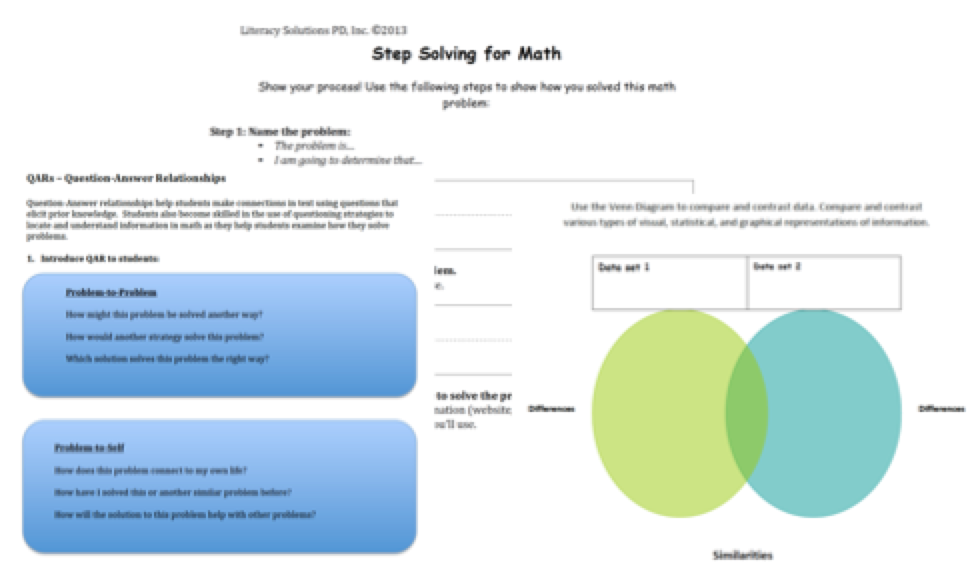 promote “meaningful engagement in real-world applications of learning” (p. 19), and through peer mediated instructional strategies. The following recommendations are made in sequential order (Israel, et al., 2013):
- Get to know the students by evaluating what their interests are, and what their views are for careers. Help them set their own goals accordingly. Students with IEPs in place often have vocational and transitive goals once they are 14 years of age.
- Encourage visual representation of ideas, such as the drawing of pictures of career-related concepts as they apply to their own lives to enable them to envision themselves in their careers of choice or of interest.
- Use graphic organizers and have students assist in their development through co-construction. Examples include: KWL (know-want to know-learned), KWHLs (know-want to know-how I will learn it- learned).
- Build inquiry into the explicit teaching of reading strategies to include vocabulary, text structure, use of relevant background knowledge, comprehension and construction of new knowledge through before, during, and after strategies.
The following are recommendations for scaffolding by using a before, during, and after approach to reading:
Before Reading: Pre-teach essential vocabulary, new or unknown words – carefully select them. Examples: orbit, asteroid, rotation
- Display the words on a Science Words, Everyday Words chart
- Survey the text prior to reading to make predictions, review pictures and captions, subtitles
- Use SQ3R, THIEVES , quick write strategies.
During Reading: Encourage students to self-monitor comprehension by demonstrating your own process of self-monitoring, thinking outloud as you read.
- Teach the use of context clues, using surrounding text to uncover meaning of new or unknown words. This can also be achieved by pre-teaching vocabulary, exploring first the word by itself, its context, predicting meaning, then the dictionary or glossary definition.
- Teach students how text is organized through analyzing text structure and purposes for organization. Example: a chapter might describe a sequence of something, with the next chapter focusing on compare and contrast of the same ideas. Point out and teach students how and why authors organize text for various purposes, and how it feeds deeper comprehension.
- Teach paraphrasing, restating the main idea and important details in their own words
- Facilitate making connections to prior knowledge and students’ own experiences through brainstorming and discussions about previous experiences related to new concepts.
After Reading: Integrate newly acquired knowledge about content and vocabulary while supporting comprehension through learning logs and graphic organizers. All materials named can be found in the Course Objectives | Research | Materials folder.
Semantic Feature Analysis: An engaging strategy that requires students to relate selected vocabulary to key features of the text they are reading using a matrix. Students discover how one set of things is related to one another by developing understanding the meaning of selected vocabulary, grouping vocabulary words into logical categories, and analyzing the matrix overall.
Learning Logs: Learning logs help students to understand content, the process behind understanding, and document personal reactions to reading. Rather than write what they learned, students respond in learning logs or reflective notebooks to articulate understanding at the close of each class or on the completion of a block of work using short and frequent bursts of writing versus through longer assignments.
Graphic organizers: Graphic organizers guide and scaffold student thinking by facilitating the classification of ideas in organized, structured manner. Organizers help students develop writing, problem solving, decision making studying, planning, research, and brainstorming.
Reciprocal Teaching: Students take on the role of teacher in reciprocal teaching, while working individually and/or collaboratively with peers. Text is chunked as students work together to construct meaning, with the teacher thinking aloud at each step to guide them until they can do it independently. Responsibility for the process is handed over gradually as they become more proficient at predicting, asking questions, and summarizing. Skills are scaffolded where students become the leaders, with little assistance from the teacher to reciprocate the teaching and learning roles.
Interactive reading guides: Interactive reading guides help students to navigate reading, and are useful for struggling readers who need assistance reading challenging text. Students are provided with a guide of prompts as they read an assigned text to comprehend main ideas and develop facility with a text's organization. Reading guides can be used in whole class, groups, or individually via graphic organizer.
Scaffolding Through Modeling Literacy – Thinking Outloud
Models of literacy are powerful teaching methods, and effective ways to scaffold for students as they first observe before having responsibility be slowly turned over to them. This is the "I do, you watch; you do, I watch" model. Modeling our own reading and writing process while “thinking aloud” works remarkably well to “unstick” readers and writers who might have trouble getting started with their ideas, or know where to begin in a text. Thinking through our own reading process is a strategy that offers readers the assurance they need in knowing that they have partners in strategy, while serving as a sound example.
Literacy models that scaffold include shared reading and writing with, “I do, you watch and then you do, I watch”, and guided reading and writing all funnel responsibility gradually and strategically. Authentic and effective literacy approaches are based on the very characteristics that experienced readers and writers use – active engagement, high interaction, and constant meaning negotiation. The more successful students are, the more enthusiastic they’ll become about reading and writing.
Strategies that Teach Reading and Writing Strategies Across The Curriculum (See Course Objectives | Research | Materials folder for guides and organizers):
- Think-aloud strategies
- Previewing text
- Self-monitoring and self-correction strategies
- Summarization strategies
- Discussions with peers
- Engagement in the full writing process: pre-writing, drafting, revising, publishing
- Twin Text Strategy
- PRC2 – Partner Reading and Content Too
- Use of common graphic organizers
- KWL Charts
- Common note-taking: Frayer Note-taking, Double-column notesPre-teaching vocabulary
- Think-pair-share strategies
- New literacy strategies
- Modeled writing using 21st century technologies
- Student engagement using vocabulary and high interest topics or writing
- Reciprocal teaching
- Use of hyper text and digital reading in collaborative environments
Israel, M., Maynard, K., & Williamson, P. (2013). Promoting literacy-embedded, authentic STEM instruction for students with disabilities and other struggling learners. Teaching Exceptional Children, 45(4), 18-25.
