Tiering and Scaffolding
| Site: | Literacy Solutions On-Demand Courses |
| Course: | Methods of Instruction for ELLs, Grades K-12 - No. ELL-ED-112 |
| Book: | Tiering and Scaffolding |
| Printed by: | Guest user |
| Date: | Wednesday, July 15, 2026, 2:11 AM |
Description
x
1. Scaffolding
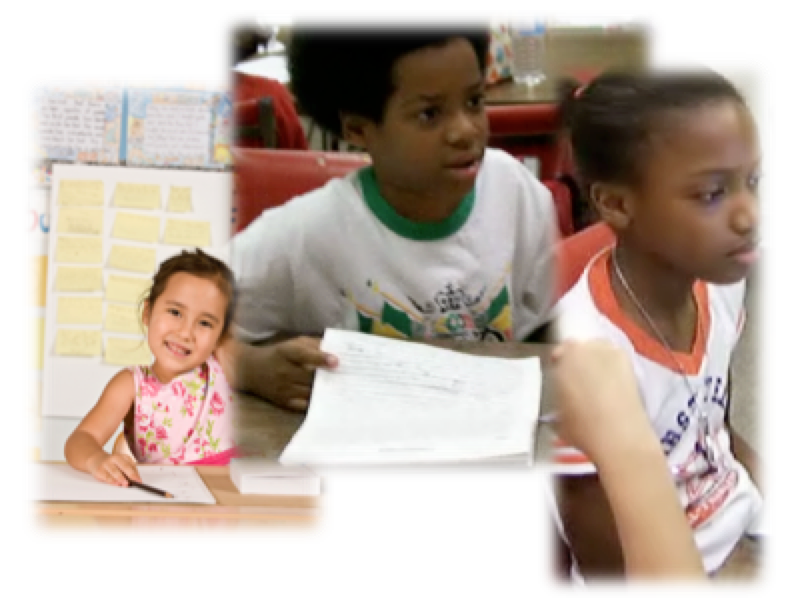
By definition, and in its purest sense, a scaffold is a "temporary structure for holding workers and materials during the erection, repair, or decoration of a building." In K-12 education, scaffolding involves maintaining a steadfast approach in support of a curriculum until a student is ready to be further challenged. It is a gradual release of responsibility to students in increments they can handle pedagogically, and developmentally. It usually begins with a teacher's modeling of a concept or a skill, with the responsibility handed off to students until they can handle all of it independently. This is called building student capacity. This is also based on Bloom's Zone of Proximal Development (Vygotsky, 1978), the gap between what a learner has mastered and what a learner can achieve on his or her own with sufficient support. As students increase their ability, or as the gap closes, teachers decrease the scaffolds until they can do it independently. A thinking map graphic organizer is a good example of this, where one map might include lots of boxes and prompts, the next less, and finally the organizer is removed to allow a student the opportunity to apply the thinking independent of the organizer, holding him or her accountable for the same results.
Use of context clues, brainstorming questions, pre-teaching vocabulary, providing reinforcement through word charts, word walls, and modeling text paraphrasing strategies are among the scaffolding strategies used to get students from Point A to Point B by differentiating (Israel, Maynard & Williamson, 2013).
Due to the abstract nature of some subjects, many students often struggle and under perform for many reasons (Brigham, Scruggs & Mastropieri, 2011 In: Israel, et al., 2013). Some of the challenges for these students include:
- Challenging vocabulary
- Complex, multi-step problems
- Curriculum designed with concepts taught in isolation.
Not surprisingly, about 5% of students with disabilities enter the STEM workforce (Leddy, 2010 in: Israel, 2013). Literacy embedded, evidence-based strategies can be used in differentiated settings in general education classes through collaborative learning, authenticated learning experiences that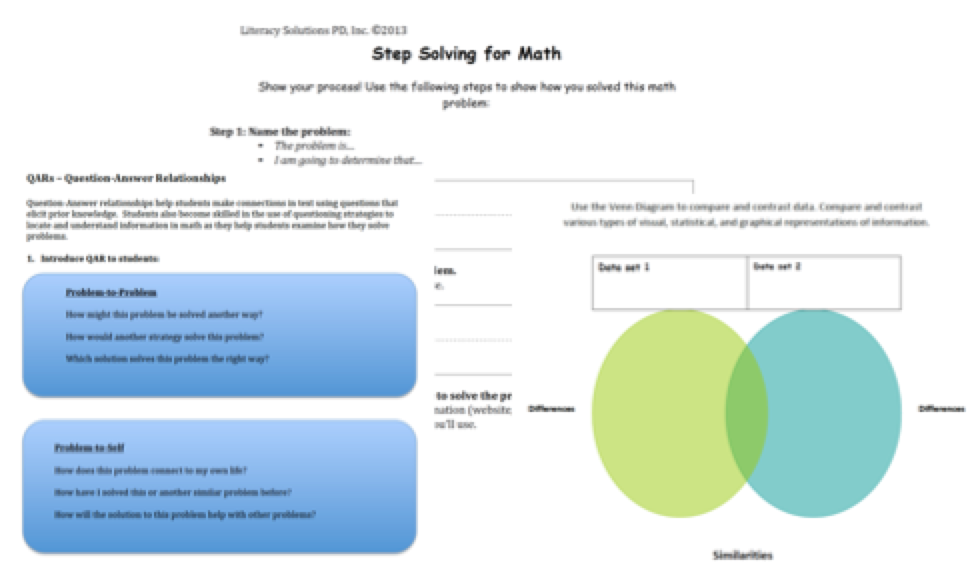 promote “meaningful engagement in real-world applications of learning” (p. 19), and through peer mediated instructional strategies. The following recommendations are made in sequential order (Israel, et al., 2013):
- Get to know the students by evaluating what their interests are, and what their views are for careers. Help them set their own goals accordingly. Students with IEPs in place often have vocational and transitive goals once they are 14 years of age.
- Encourage visual representation of ideas, such as the drawing of pictures of career-related concepts as they apply to their own lives to enable them to envision themselves in their careers of choice or of interest.
- Use graphic organizers and have students assist in their development through co-construction. Examples include: KWL (know-want to know-learned), KWHLs (know-want to know-how I will learn it- learned).
- Build inquiry into the explicit teaching of reading strategies to include vocabulary, text structure, use of relevant background knowledge, comprehension and construction of new knowledge through before, during, and after strategies.
The following are recommendations for scaffolding by using a before, during, and after approach to reading:
Before Reading: Pre-teach essential vocabulary, new or unknown words – carefully select them. Examples: orbit, asteroid, rotation
- Display the words on a Science Words, Everyday Words chart
- Survey the text prior to reading to make predictions, review pictures and captions, subtitles
- Use SQ3R, THIEVES , quick write strategies.
During Reading: Encourage students to self-monitor comprehension by demonstrating your own process of self-monitoring, thinking outloud as you read.
- Teach the use of context clues, using surrounding text to uncover meaning of new or unknown words. This can also be achieved by pre-teaching vocabulary, exploring first the word by itself, its context, predicting meaning, then the dictionary or glossary definition.
- Teach students how text is organized through analyzing text structure and purposes for organization. Example: a chapter might describe a sequence of something, with the next chapter focusing on compare and contrast of the same ideas. Point out and teach students how and why authors organize text for various purposes, and how it feeds deeper comprehension.
- Teach paraphrasing, restating the main idea and important details in their own words
- Facilitate making connections to prior knowledge and students’ own experiences through brainstorming and discussions about previous experiences related to new concepts.
After Reading: Integrate newly acquired knowledge about content and vocabulary while supporting comprehension through learning logs and graphic organizers. All materials named can be found in the Course Objectives | Research | Materials folder.
Semantic Feature Analysis: An engaging strategy that requires students to relate selected vocabulary to key features of the text they are reading using a matrix. Students discover how one set of things is related to one another by developing understanding the meaning of selected vocabulary, grouping vocabulary words into logical categories, and analyzing the matrix overall.
Learning Logs: Learning logs help students to understand content, the process behind understanding, and document personal reactions to reading. Rather than write what they learned, students respond in learning logs or reflective notebooks to articulate understanding at the close of each class or on the completion of a block of work using short and frequent bursts of writing versus through longer assignments.
Graphic organizers: Graphic organizers guide and scaffold student thinking by facilitating the classification of ideas in organized, structured manner. Organizers help students develop writing, problem solving, decision making studying, planning, research, and brainstorming.
Reciprocal Teaching: Students take on the role of teacher in reciprocal teaching, while working individually and/or collaboratively with peers. Text is chunked as students work together to construct meaning, with the teacher thinking aloud at each step to guide them until they can do it independently. Responsibility for the process is handed over gradually as they become more proficient at predicting, asking questions, and summarizing. Skills are scaffolded where students become the leaders, with little assistance from the teacher to reciprocate the teaching and learning roles.
Interactive reading guides: Interactive reading guides help students to navigate reading, and are useful for struggling readers who need assistance reading challenging text. Students are provided with a guide of prompts as they read an assigned text to comprehend main ideas and develop facility with a text's organization. Reading guides can be used in whole class, groups, or individually via graphic organizer.
Scaffolding Through Modeling Literacy – Thinking Outloud
Models of literacy are powerful teaching methods, and effective ways to scaffold for students as they first observe before having responsibility be slowly turned over to them. This is the "I do, you watch; you do, I watch" model. Modeling our own reading and writing process while “thinking aloud” works remarkably well to “unstick” readers and writers who might have trouble getting started with their ideas, or know where to begin in a text. Thinking through our own reading process is a strategy that offers readers the assurance they need in knowing that they have partners in strategy, while serving as a sound example.
Literacy models that scaffold include shared reading and writing with, “I do, you watch and then you do, I watch”, and guided reading and writing all funnel responsibility gradually and strategically. Authentic and effective literacy approaches are based on the very characteristics that experienced readers and writers use – active engagement, high interaction, and constant meaning negotiation. The more successful students are, the more enthusiastic they’ll become about reading and writing.
Strategies that Teach Reading and Writing Strategies Across The Curriculum (See Course Objectives | Research | Materials folder for guides and organizers):
- Think-aloud strategies
- Previewing text
- Self-monitoring and self-correction strategies
- Summarization strategies
- Discussions with peers
- Engagement in the full writing process: pre-writing, drafting, revising, publishing
- Twin Text Strategy
- PRC2 – Partner Reading and Content Too
- Use of common graphic organizers
- KWL Charts
- Common note-taking: Frayer Note-taking, Double-column notesPre-teaching vocabulary
- Think-pair-share strategies
- New literacy strategies
- Modeled writing using 21st century technologies
- Student engagement using vocabulary and high interest topics or writing
- Reciprocal teaching
- Use of hyper text and digital reading in collaborative environments
Israel, M., Maynard, K., & Williamson, P. (2013). Promoting literacy-embedded, authentic STEM instruction for students with disabilities and other struggling learners. Teaching Exceptional Children, 45(4), 18-25.

2. Tiered Questioning as Scaffolding and Differentiation
Tiering is another way of scaffolding, and a strong way to build student capacity by differentiating for teaching with complex or challenging text. While it is important to remember that struggling students must read at their level of reading independently, when teaching them directly, such as when we demonstrate a strategy or teach new content, per the FSS we must teach them with grade-level text. In doing so, tiering can become your best friend.
After reviewing assessment data, tiering activities for various learning is useful to further differentiate. It might involve corrective action through an intervention activity, and/or it might involve enrichment or extension activities for others - or both. Intervention activities should always present concepts in new ways to keep students engaged, and to reinforce concepts not previously understood (Guskey, 2008). Forging new and different pathways to reinforce understand is key, but it's also the challenge. Changing format, organization of activities, or even the mode of delivery are effective steps to take when formatting corrective activities to differentiate instruction with (Guskey, 2008).
Tiered questioning is a method of questioning that works to deepen student understanding as individual needs dictate. Various activities are planned specific to each students' level, as determined through a pre-assessment, focused on essential concepts and skills. Tiered questioning is designed to move students slightly beyond their comfort-level and challenge them enough to scaffold to mastery. Below are two models of tiered questioning, with Teaching Channel video demonstration of classroom application. Stay tuned!
Costa's Level of Questioning - found in the Course Objectives | Research | Materials folder:
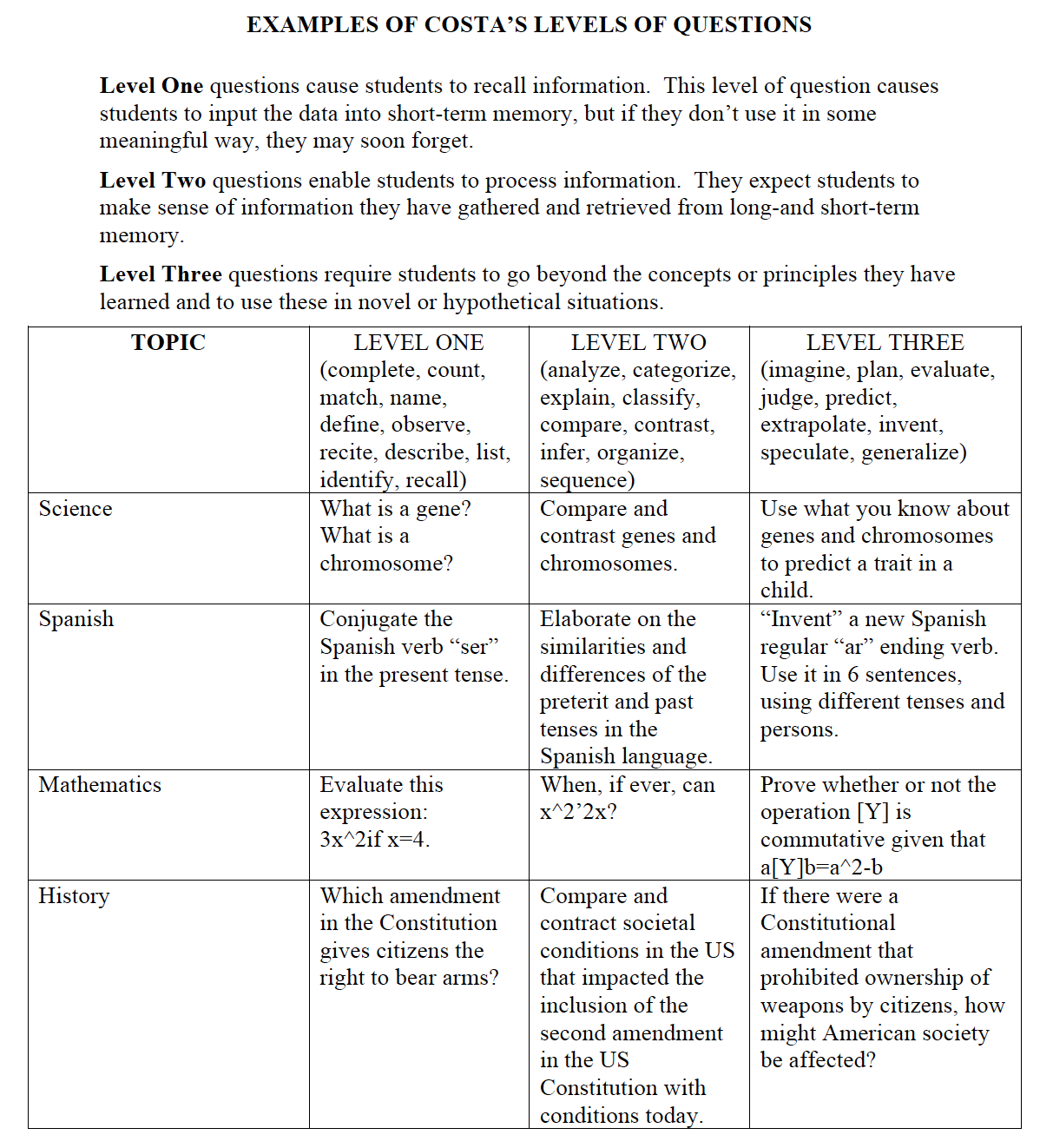
Level One:
In level one questioning, students use information for short-term recall, not in a meaningful way therefore isn’t retained.
Level Two:
At level two students process information to make meaningful connections, and later retrieve it from both long-term and short-term memory.
Level Three:
At level three students apply information, concepts and principles learned to novel and hypothetical situations.
QAR - Question/Answer/Recall - found in the Course Objectives | Research | Materials folder:
Question-Answer relationships help students make connections in text using questions that elicit prior knowledge. Students also become skilled in the use of questioning strategies to locate and understand information. Reading passages are scaffolded as students apply the strategy to increasingly longer passages.
Self-Questioning by Buehl - found in the Course Objectives | Research | Materials folder:
Students use the Taxonomy for Self-Questioning (Buehl, D. 2009), to generate questions across several content areas using multiple texts. They raise questions while reading to get deeper into thinking and comprehension. Through self-questioning, students independently apply the revised Bloom’s Taxonomy in the following areas: creating, evaluating, analyzing, applying, understanding, remembering. Students use metacognition, or the monitoring of their own reading strategy, to develop and answer questions while they read. This questioning approach can be applied to all content areas.
Buehl, D. (2009). Classroom Strategies for Interactive Learning. Newark, DE: IRA.
Guskey, T. R. (Ed.). (2009). Practical solutions for serious problems in standards-based grading. Thousand Oaks, CA: Corwin Press.
3. Integrating Listening, Speaking, Reading, and Writing
The ability to speak English fluently is critical to our ELLs’ success both inside and outside the classroom. They must pass a speaking portion of a language proficiency assessment to score out of ESOL services and be fully immersed in mainstream classes without support. Integrating  every day reading, writing, listening, and speaking is a natural experience in both oral and written forms. They shouldn't be taught in isolation, because they do not occur in isolation. When reading the Sunday newspaper for example, we stop to comment on something, share new information, or share outrage with a friend, a sibling, spouse, or another in the room. We often stop to reread, both fiction and non-fiction, when we need to clarify information. Children and adults learning a new language are always in need translation in many on-the-spot circumstances - at the doctor's corner store, library, school, store. Listening, speaking, reading and writing occur naturally at school in all grade levels.
In primary grades fore example, the teacher would read a picture book aloud, point to the pictures, show the pictures, take time to let students orally predict what might happen next or discuss the pictures, characters, or plot. Older students might perform a play, write a script to a play, have long discussions about literature interpretation, or talk about results and outcomes. When students write anything, they typically like to read what they wrote, get feedback from peers, and comment on their writing and the writing of others. this is a listening, reading, writing, speaking process that occurs in any order, on any given day, in or outside of school.
When we plan instruction, we need to plan reading, writing, listening and speaking intentionally throughout all subject areas with opportunities to discuss, interpret, demonstrate, write, and listen to others.
Speakers of Other Languages
The four language processes of listening, speaking, reading, and writing come together quite nicely, and in a similar interactive way, for ELLs. By about the age of five, children typically become grammatically competent in their mother tongue, or the language spoken at home. The rest of it happens through expanded vocabularies, and exposure within context for which language is used daily both in school and out of school. Reading and writing competencies on the other hand, develop much later, and aren't achieved as much by similar immersion. Thus, oral language development occurs earlier and more fully than written in first language acquisition.
For young ELLs with little literacy in the home, basic oral language competence will emerge earlier than reading and writing competencies (Fradd & McGee, 1994). For older students who can read proficiently in their first language, the pattern differs. These students may develop competence in writing earlier than oral. In either case, lots of time must be spent developing the oral and written language.
ELLs do not need to be fully proficient in oral English before they begin to read and write (Hudelson, 1984). Second language knowledge can develop from writing and speaking practice, provided that the text is understandable, or written at a level in which they can read (Elly & Mangubhai, 1983). The key relationships among listening, speaking, reading, and writing during development are complex relationships of mutual support.
Integration of Reading, Writing, Listening, Speaking in the Classroom
We always see a number of students, from every cultural background, who are too shy to speak up in the classroom or to answer a question, even when they have the answer. These strategies help all students improve their language development in a supportive, encouraging way. At the end of the list are some strategies specific to helping ELLs acquire and use oral language.
- Model language by saying aloud and writing the ideas and concepts you’re teaching.
- Model what a fluent reader sounds like through focused read-alouds.
- Be explicit. Give each activity you do a name, the simplest and most accurate name that you can, and then repeat the activity, so students can learn the verbal and written cues and procedures.
- Tell students what they are learning about each day and whether they will be reading, writing, listening, or speaking.
- Make expectations clear for behavior, written assignments, independent practice, and group work. Write key expectations on a chart and keep the chart posted for reference.Use a rubric whenever possible to help students evaluate their behavior and work.
- Have students retell stories aloud. Record their retellings in their own words to create a language experience chart that can be used for future reading and writing lessons with this group.
- Teach choral speaking and reading (poetry may be the most accessible format with which to begin).
- Sing or read songs. Children can bring in a favorite song to perform alone or as a group, but make sure you have heard the song first and can approve it.
- Have students read and perform Readers Theater scripts.
- Practice dictation, especially for learning spelling. Allow students to take turns dictating, too. Use full sentences for contextualizing the spelling words.
- Experiment with speaking and writing in different tenses and using different types of expressive language. For example, say the same word or phrase using a tone that is happy, sad, angry, and so forth. Use facial expressions—a smile, frown, or quizzical look—to embed more meaning in your speech. For beginners, hold up picture cards showing expressive faces and have them act out these expressions.
- Explain by showing, not just telling. Act it out if you have to or use visual tools such as sketches and diagrams or actual objects.
- Correct content, not grammar. To model proper grammar and syntax, restate or rephrase students’ questions or statements. You can do this in writing too.
Student: I put mines pencil on that desk.
Teacher: I put my pencil on that desk, too.
OR
Student: Who go to bring lunch count today?
Teacher: Hmmm, let’s see . . . Who is going to bring the lunch count to the office today?
- To express proper intonation and pitch, be aware that you modulate your voice, make adjustments in tone, and use a range of pitch with everything you say to your students. We do this naturally anyway; for example, our voices rise at the end of a question.
- When asking questions, give choices for the answer. This will also help you check for understanding especially in the earlier stages of language acquisition. For example, ask, “Would you like pizza or a bagel for lunch?” Or, after reading a story, ask, “Did the first pig build his house of bricks or straw?”
- Respond to the interests of the children. Provide reading, speaking, listening, and writing
activities and opportunities in which students can share their hobbies and interests. - Encourage students to describe, summarize, define, contrast, and compare by modeling. Be sure to show and not just tell when teaching a new concept, idea, or vocabulary.
- Be your own glossary. If you use an unfamiliar word, define it for the class as part of your lesson.
- Don’t assume that students truly understand the subject being discussed just because they are nodding and even answering your questions. Monitor what you say to make sure that they understand. When in doubt, ask the class to restate the directions you’ve given or the ideas you’ve presented.
- Ask students to give multiple meanings of a particular word or tell whether it can be labeled a verb or a noun. This will help students sharpen their grammar skills and place ideas in the context of your discussion.
- Develop vocabulary over time, in different learning contexts—use the target words in large and small groups and one-on-one formats. Post vocabulary words in the room on chart paper.
References:
Abedi, J. (Ed.). (2007). English language proficiency assessment in the nation: Current status and future practice (Report). Davis, CA: University of California. Retrieved May 7, 2010, from http://education.ucdavis.edu/research/elp_report.pdf
Ariza, E. N. (2010). Not for ESOL Teachers: What Every Classroom Teacher Should Know About Linguistically, Culturally, and Ethnically Diverse Students. New York, NY: Allyn & Bacon/Pearson Education.
Moran, P. P., & Greenberg, B. (2008). Peer Revision: Helping Students to Develop a Meta Editor, Ohio Journal of English Language Arts. Vol. 48, pp. 33-39.
Ganske, Kathy; Monroe, Joanne K.; Strickland, Dorothy S. Questions teachers ask about struggling readers and writers. Reading Teacher, Oct. 2003, Vol. 57 Issue 2
Yang, M., Badger, R., & Yu, Z. (2006). A comparative study of peer and teacher feedback in a
Chinese EFL writing class. Journal of Second Language Writing, 15(3), 179-200.