Tiering and Scaffolding
x
2. Tiered Questioning as Scaffolding and Differentiation
Tiering is another way of scaffolding, and a strong way to build student capacity by differentiating for teaching with complex or challenging text. While it is important to remember that struggling students must read at their level of reading independently, when teaching them directly, such as when we demonstrate a strategy or teach new content, per the FSS we must teach them with grade-level text. In doing so, tiering can become your best friend.
After reviewing assessment data, tiering activities for various learning is useful to further differentiate. It might involve corrective action through an intervention activity, and/or it might involve enrichment or extension activities for others - or both. Intervention activities should always present concepts in new ways to keep students engaged, and to reinforce concepts not previously understood (Guskey, 2008). Forging new and different pathways to reinforce understand is key, but it's also the challenge. Changing format, organization of activities, or even the mode of delivery are effective steps to take when formatting corrective activities to differentiate instruction with (Guskey, 2008).
Tiered questioning is a method of questioning that works to deepen student understanding as individual needs dictate. Various activities are planned specific to each students' level, as determined through a pre-assessment, focused on essential concepts and skills. Tiered questioning is designed to move students slightly beyond their comfort-level and challenge them enough to scaffold to mastery. Below are two models of tiered questioning, with Teaching Channel video demonstration of classroom application. Stay tuned!
Costa's Level of Questioning - found in the Course Objectives | Research | Materials folder:
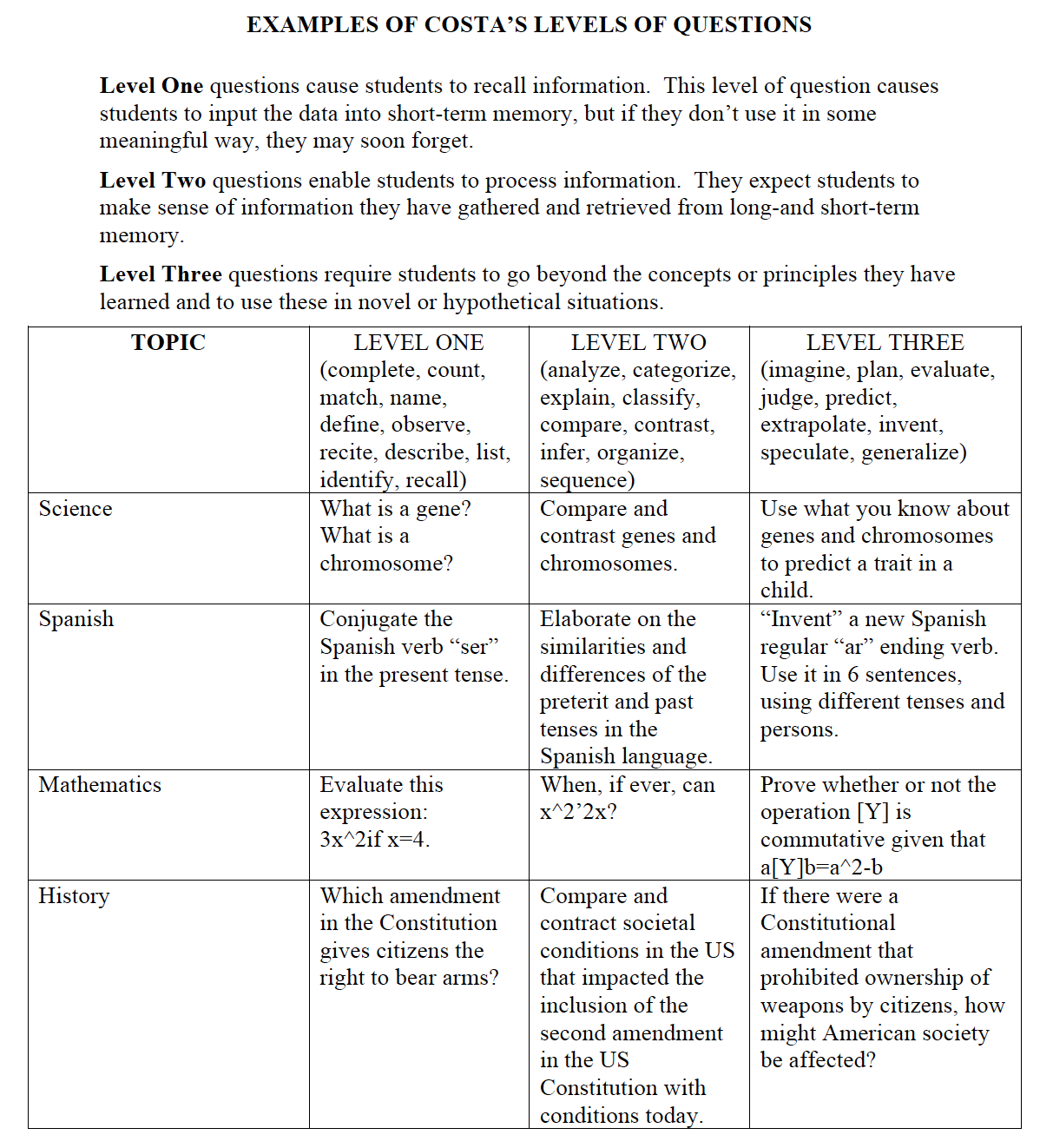
Level One:
In level one questioning, students use information for short-term recall, not in a meaningful way therefore isn’t retained.
Level Two:
At level two students process information to make meaningful connections, and later retrieve it from both long-term and short-term memory.
Level Three:
At level three students apply information, concepts and principles learned to novel and hypothetical situations.
QAR - Question/Answer/Recall - found in the Course Objectives | Research | Materials folder:
Question-Answer relationships help students make connections in text using questions that elicit prior knowledge. Students also become skilled in the use of questioning strategies to locate and understand information. Reading passages are scaffolded as students apply the strategy to increasingly longer passages.
Self-Questioning by Buehl - found in the Course Objectives | Research | Materials folder:
Students use the Taxonomy for Self-Questioning (Buehl, D. 2009), to generate questions across several content areas using multiple texts. They raise questions while reading to get deeper into thinking and comprehension. Through self-questioning, students independently apply the revised Bloom’s Taxonomy in the following areas: creating, evaluating, analyzing, applying, understanding, remembering. Students use metacognition, or the monitoring of their own reading strategy, to develop and answer questions while they read. This questioning approach can be applied to all content areas.
Buehl, D. (2009). Classroom Strategies for Interactive Learning. Newark, DE: IRA.
Guskey, T. R. (Ed.). (2009). Practical solutions for serious problems in standards-based grading. Thousand Oaks, CA: Corwin Press.