Rubrics, Reading Inventories, and More
no insert
1. Reading and Writing Rubrics
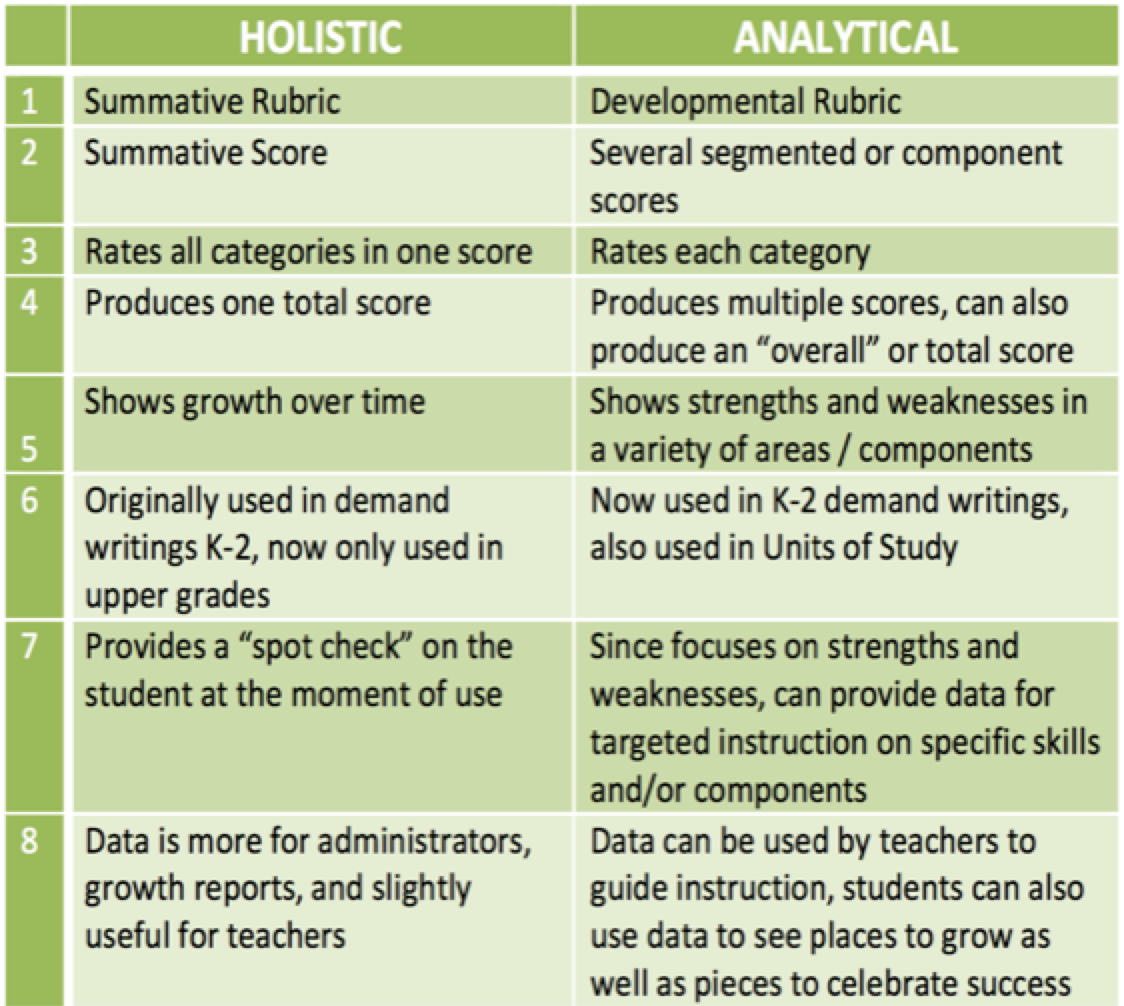
There are two kinds of rubrics:
- Holistic: a set of interrelated tasks that contribute to a whole along a continuum of quality.
- Analytical: breaks down the objectives, or product, into parts with each part scored separately.
All rubrics are:
- Performance based, used while students are working and/or directly in follow-up to a task or activity
- Authentic, and used in, and alongside, real reading and writing tasks.
- Formative, used for formative assessment as a student self-check, in peer review, or as a final culminating grade through the entire learning spectrum for a project or series of tasks related to a project.
Rubrics are evaluation tools used to aid writers in editing and evaluating their work. They serve as smart reminders of what to pay attention to. When a writer has finished using a rubric to evaluate his or her own writing, he/she usually comes out with a stronger understanding of what needs to be done next to improve the writing.
A rubric is a scoring guide. It organizes criteria that describe what students need to complete for an assignment, and it measures the levels of proficiency of student work. Rubrics can be used in any subject area or for any writing genre. They allow students and parents to know exactly how a teacher will grade an assignment.
Rubrics can range from simple to complex. However, there are common elements that make some rubrics better than others. Examine the following three example pictures of rubrics.
In the rubric examples presented on the previous page, what made some better than others? What were some of their common elements?
First, rubrics should clearly communicate expectations on a set of criteria. The criteria lets a person know exactly what is being scored. The better the description of the criteria, the better the rubric. In the pictures you saw on the previous page, the burger rubric communicated expectations, but the expectations were not really defined or clear, like in the other two examples.
Secondly, rubrics need to contain a scale or level of performance for each criteria. This scale should be described for each criteria. Many times, rubrics contain only quality words like "poor", "good", "excellent". However, these are very subjective words without having clear examples of what evidence should be used so that a person knows what is needed or required at each level. The book cover and discussion rubrics do not have clearly stated evidence.
The more detail the descriptions have, the easier the rubric is to use. Consider this example used to score a "Self-Introduction Presentation."
- Using a holistic strategy, the scorer takes all of the evaluative criteria into consideration but aggregates them to make a single, overall quality judgment.
- An analytic strategy requires the scorer to render criterion-by-criterion scores that may or may not ultimately be aggregated into an overall score.
- Think about the criteria that are important for a given performance or product by examining samples of student work at the novice, intermediate, and advanced proficiency levels and considering the characteristics of each level.
- Limit the number of criteria so that the rubric is no longer than one page and includes what is most important. Then develop quality descriptions for each criterion and its levels, keeping in mind the proficiency level of the student work.
- Focus descriptions of quality on the positive (e.g., what is present in the performance, what students show that they know and are able to do) rather that on the negative (e.g., what is missing, what students inaccurately do).
From Professional Development Module V: Developing Rubrics for Performance-Based Assessment (p. HO-9), by D. Cox, B. Dunn, E. Phillips, and C. Reese, 2002, Austin, TX: Southwest Educational Development Laboratory (SEDL), Languages Other Than English, Center for Educator Development in collaboration with Texas Education Agency, Education Service Center, Region II. Copyright © SEDL. Retrieved from http://www.sedl.org/loteced/opdc/resources/constructing_rubrics.pdf on the SEDL website.