Rubrics, Reading Inventories, and More
| Site: | Literacy Solutions On-Demand Courses |
| Course: | Methods of Instruction for ELLs, Grades K-12 - No. ELL-ED-112 |
| Book: | Rubrics, Reading Inventories, and More |
| Printed by: | Guest user |
| Date: | Wednesday, July 15, 2026, 3:51 AM |
Description
no insert
1. Reading and Writing Rubrics
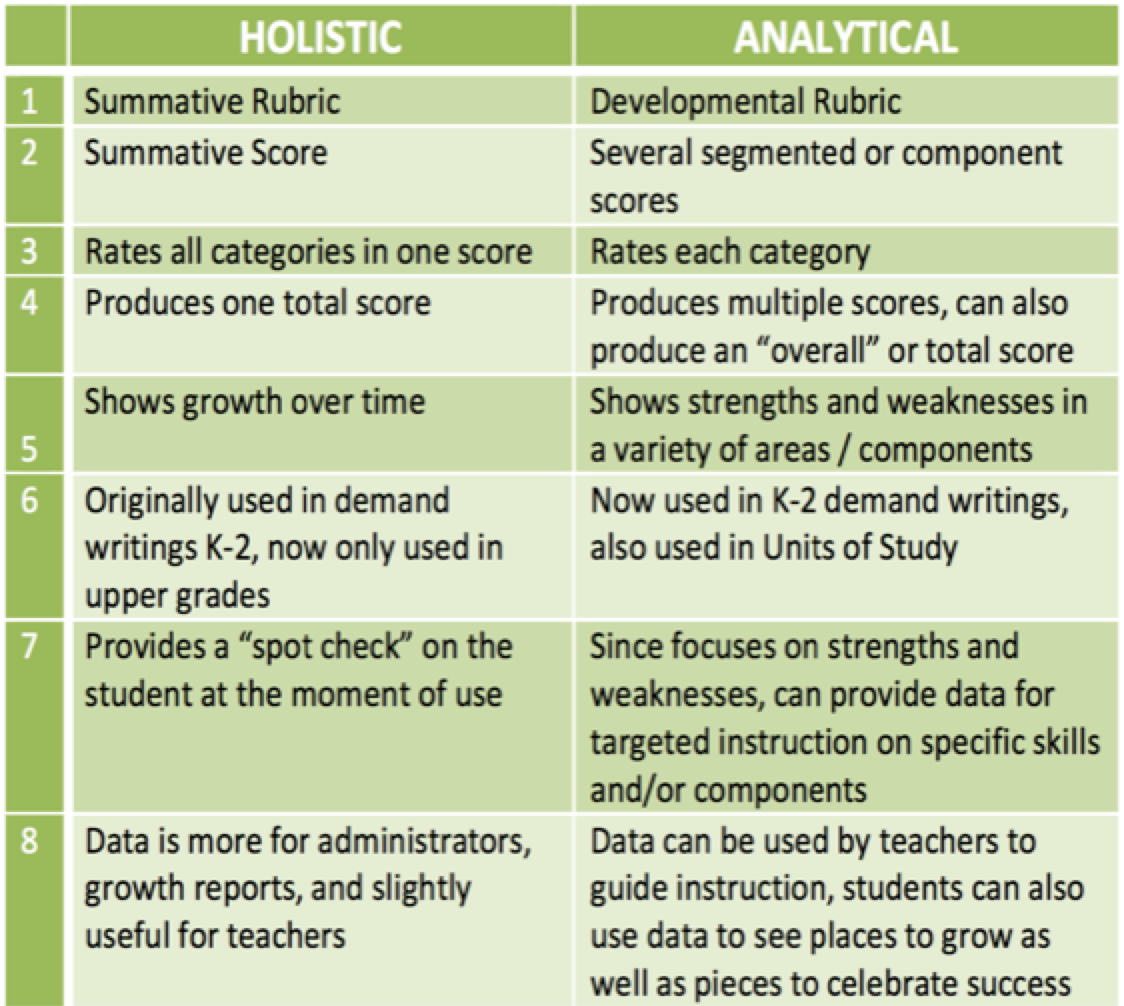
There are two kinds of rubrics:
- Holistic: a set of interrelated tasks that contribute to a whole along a continuum of quality.
- Analytical: breaks down the objectives, or product, into parts with each part scored separately.
All rubrics are:
- Performance based, used while students are working and/or directly in follow-up to a task or activity
- Authentic, and used in, and alongside, real reading and writing tasks.
- Formative, used for formative assessment as a student self-check, in peer review, or as a final culminating grade through the entire learning spectrum for a project or series of tasks related to a project.
Rubrics are evaluation tools used to aid writers in editing and evaluating their work. They serve as smart reminders of what to pay attention to. When a writer has finished using a rubric to evaluate his or her own writing, he/she usually comes out with a stronger understanding of what needs to be done next to improve the writing.
A rubric is a scoring guide. It organizes criteria that describe what students need to complete for an assignment, and it measures the levels of proficiency of student work. Rubrics can be used in any subject area or for any writing genre. They allow students and parents to know exactly how a teacher will grade an assignment.
Rubrics can range from simple to complex. However, there are common elements that make some rubrics better than others. Examine the following three example pictures of rubrics.
In the rubric examples presented on the previous page, what made some better than others? What were some of their common elements?
First, rubrics should clearly communicate expectations on a set of criteria. The criteria lets a person know exactly what is being scored. The better the description of the criteria, the better the rubric. In the pictures you saw on the previous page, the burger rubric communicated expectations, but the expectations were not really defined or clear, like in the other two examples.
Secondly, rubrics need to contain a scale or level of performance for each criteria. This scale should be described for each criteria. Many times, rubrics contain only quality words like "poor", "good", "excellent". However, these are very subjective words without having clear examples of what evidence should be used so that a person knows what is needed or required at each level. The book cover and discussion rubrics do not have clearly stated evidence.
The more detail the descriptions have, the easier the rubric is to use. Consider this example used to score a "Self-Introduction Presentation."
- Using a holistic strategy, the scorer takes all of the evaluative criteria into consideration but aggregates them to make a single, overall quality judgment.
- An analytic strategy requires the scorer to render criterion-by-criterion scores that may or may not ultimately be aggregated into an overall score.
- Think about the criteria that are important for a given performance or product by examining samples of student work at the novice, intermediate, and advanced proficiency levels and considering the characteristics of each level.
- Limit the number of criteria so that the rubric is no longer than one page and includes what is most important. Then develop quality descriptions for each criterion and its levels, keeping in mind the proficiency level of the student work.
- Focus descriptions of quality on the positive (e.g., what is present in the performance, what students show that they know and are able to do) rather that on the negative (e.g., what is missing, what students inaccurately do).
From Professional Development Module V: Developing Rubrics for Performance-Based Assessment (p. HO-9), by D. Cox, B. Dunn, E. Phillips, and C. Reese, 2002, Austin, TX: Southwest Educational Development Laboratory (SEDL), Languages Other Than English, Center for Educator Development in collaboration with Texas Education Agency, Education Service Center, Region II. Copyright © SEDL. Retrieved from http://www.sedl.org/loteced/opdc/resources/constructing_rubrics.pdf on the SEDL website.
2. Interest Inventories
Informal Reading Assessments
See The Teacher's Cafe for Inventories and other Assessments: http://theteacherscafe.com/Teacher-Directory/Reading-Assessments.htm
Also see the Course Objectives | Research | Materials folder, and the Reading Formative Assessments folder in this module
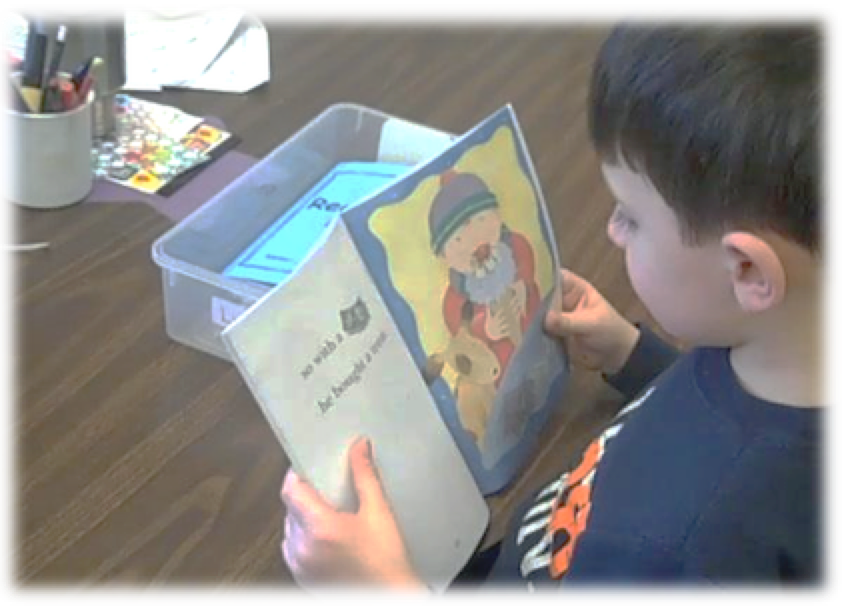
Informal reading assessments are qualitative assessments that measure the following:
- Grade level reading
- Fluency
- Comprehension
- Vocabulary
- Oral reading accuracy
Struggling readers typically avoid reading. They have come to dislike it for a number of reasons: they just don't like to read, are avoiding the act of reading altogether, or because classroom reading material is too difficult. They don’t like to be embarrassed reading aloud, getting "caught" not understanding what they read, and have simply become frustrated because the task of reading. Study after study has shown that students who read independently practice their reading skills and become better readers as a result. These are the motivated readers, motivated either by a good grade, the read itself, or because they are students who like to achieve. Struggling readers, different story.
Whether the child is a struggling reader or an unmotivated reader, finding his/her independent, instructional, and frustration reading levels is a necessary first step in motivating him/her to read. Equally as important, finding out what interests them in the topics they like to read about, genres (fiction, non-fiction, articles, editorials, car magazines, etc.). Administering an interest inventory at the beginning of the school year can help us to identify the reading materials likely to engage them, as well as identify follow-up activities to further engage and keep them reading and learning such as literature circles, book clubs, projects, and even writing topics for follow-up reading.
Interview and Reading Inventory Suggestions:
Student interviews: Students can interview one another and report back results, or teachers can interview them via survey or personal student-teacher conferences. Very young and/or struggling readers may need  to have the survey questions read aloud to them, or one can be developed online using visuals and prompts. You might also conduct a survey of reading interests in small groups. Collect five or six titles from your library from a few different genres (folk tales, humor, fantasy, realistic fiction, etc.).
Conduct book reads yourself, or invite the school librarian or media specialist in to conduct a book read. Display the books in front of the group, showcasing the cover and backside pictures. Tell students what you're about to do, and follow with a reading of the title, first page or paragraph, and a few "blurbs" on the inside cover to get them interested. Don't give away the ending! Ask for a show of hands or a fist-to-five technique to let you know how many are interested in the book, and if the story interests them. After reviewing all of the books, immediately invite them up to check them out (have the library stamp or database on hand). A good reading attitude survey can be found in the Elementary Reading Attitude Survey by McKenna and Kear (1990).
After the Interview or Survey
Gather the inventory or interview data and create a file for each student. You can keep the data on an index card, sticky note, log on a clipboard, or in an online database. Use the data to place them in appropriately leveled books (as determined through benchmark assessments).
Give each student a copy of his/her quantified data so that they can be reminded of what their interests are, level of reading for independent and instructional, and any other information pertinent to their making proper independent choices for reading. Remember the ultimate goal: placing the right book in their hands so that they will want to read, and read on their own frequently.
References:
Taylor, B. M., Frye, B. J., & Maruyama, G. M. (1990). Time spent reading and reading growth. American Educational Research Journal, 27 (2), 351-362.
McKenna, M.D., & Kear, D. J. (1990). Measuring attitude toward reading: A new tool for teachers. The Reading Teacher, 43(9), 626-639. Retrieved July, 2009: http://faculty.rcoe.appstate.edu/koppenhaverd/f06/3030/readings/mckenna&kear.pdf
Keeping Students Motivated About Reading:
1. Provide students with regular, daily reading time by scheduling it in either as DEAR time (Drop Everything and Read), or SSR (Sustained Silent Reading, or simply Quiet Reading Time.
- Give students access to a wide choice of reading material and allow them to choose what they want to read.
- Provide a classroom library which has books on many reading levels, as well as magazines, newspapers, graphic novels, and comic books. In the absence of an extensive classroom library, schedule a weekly trip to the school library for students to select and check out books.
- Read aloud to students daily, and model good, effective oral reading with tone, intonation, and high engagement - be a good model of oral reading.
- Tape book reads and have students check out the book and the audio taped readings of them. Invite your administrators, counselors, and special area teachers (physical education, art, music, etc.) to record their reading of the book for students to check out (students will get a kick out of hearing their other teachers read). Students need to see and hear good role models engaged in reading.
- Invite special area teachers to read to your students live when possible.
Adapted from: Using Interest Inventories with Struggling and Unmotivated Readers, By Arleen P. Mariotti
3. The Critical Reading Inventory
The authors of this study (Applegate et al., 2009) sought to determine whether there was a link in fluency and comprehension and if one inspired the other. In doing so they developed a reading comprehension of tool – The Critical Reading Inventory (CRI-2) - to measure text-based question responses, inferences, drawing conclusions and critical response to text. In addition, a component to measure fluency was included by virtue of a “fluency rubric.” The assessment was designed to distinguish between “readers who can recall information from the text and those who can think about it” (p. 51).
It was concluded that 36% of readers scored at a level that suggested they were proficient readers based on fluency, but scored low in comprehension. “It is difficult to escape the conclusion that many of these children had been judged strong readers on the basis of their pacing, accuracy and prosody alone” (p. 52). Reinforcing that it is easy to confuse good reading with fluency, but should not be confused with comprehension. “Few authors we reviewed would go so far as to suggest that the correlation between fluency and comprehension is linear or causal. Indeed many writers specifically warn against this oversimplification of such a complex interrelationship (Pikulski & Chart, 2005; Strecker, Roser & Martinez, 1998 In: Applegate et al, 2009).
Administration Procedures for The Critical Reading Inventory
- Establish rapport with the child; use the Child Interview form to assist in this activity.
- Explain the purpose and process of the assessment, answer any questions and address any concerns.
Use of Word Lists:
- Start at least two levels below grade level.
- Flash 1-second exposure using two index cards; record child’s exact (phonetic) response in case of a miscue; use “+” to indicate a correct response.
- Untimed 10- to 15-second exposure to allow the child to “decode” or correct miscues from the flash portion.
- Discontinue once the child has scored 70% or less on the Flash portion.
Reading Passages:
- Start with oral reading at the highest level at which the child attained 100% on the Flash portion of the word lists.
- Introduce the process for the passages by reading the Introductory Statement on the Examiner’s Copy of the CRI.
- Record the child’s oral reading miscues on the Examiner’s Copy, using the notation guidelines on the next page; later you will calculate the RAI and MMI for each oral read- ing passage that the child has completed.
- Remove the story from the child and ask the child to retell the story to you; record his or her retelling verbatim for scoring later. If the child does not do so in the course of the retelling, remind the child, “Tell me what you thought about the passage.”
- Ask the comprehension questions and record the child’s exact responses. Score as you go if you are an experienced user. Otherwise, estimate the level of the child’s performance so that you do not exceed the child’s Frustration Level.
- Follow the same procedures for the silent passage at each level (except, of course, for recording the oral reading performance).
- Estimate the average for the oral and the silent comprehension performance after each level is administered.
- Stop when either the oral reading performance RAI score is 90% or less or when the average (oral + silent reading comprehension/2) is 50% or less.
- Proceed to listening comprehension assessment if the child’s Instructional Level is below the child’s grade level or if you note that word recognition problems are seriously affect- ing comprehension.
- If you start with a level where the child does not obtain an “independent” score on oral reading performance and/or comprehension average, then go down a level until an independent level is established.
References:
Applegate, M. D., Applegate, A. J., & Modla, V. B. (2009). "She's my best reader; she just can't comprehend": Studying the relationship between fluency and comprehension. The Reading Teacher, 62(6), 512-521.
Applegate, M.D., Quinn, K.B., & Applegate, A.J. (2008). The critical reading inventory: Assessing students’ reading and thinking (2nd ed.). Upper Saddle River, NJ: Pearson Education.
EngageNY, January, 2015
4. Research-Based Assessment and Instructional Strategies
Research-Based Instruction and Assessment Strategies for ELLs
Downloadable version in the Course Objectives | Research | Materials folder
|
Accountable Conversation Questions |
Teach students what to say and do instead of responding with I don’t know.
|
|
APPARTS* |
APPARTS – Author, Place, Prior Knowledge, Audience, Reason, The Main Idea, Significance APPARTS provides students with a valuable analytical tool via prompts that give them a format for dissecting and analyzing primary sources.
|
|
Backwards Book Walk |
Students scan a non-fiction text briefly looking at headings, illustrations, captions, keywords, and other text features. After scanning, they answer the question: What do I think I will learn from the text? (Echevarria & Vogt, 2008). |
|
Brick and Mortar Cards |
Students are given five “brick” cards with academic vocabulary and are instructed to organize them however they think it makes sense to. Afterward, they have to link the cards together using language. They write the language they are using on “mortar” cards that they then use to tie the concepts together. Students may need lists of sentence terms and connecting words to facilitate the process. (Zwiers, 2008). |
|
Carousel Writing* |
While Carousel Writing, students will rotate topics in a small group, for a designated amount of time. With each topic, students will activate their prior knowledge of different topics or different aspects of a single topic through jotting down ideas, until eventually the original topic is back to the original owner, who will summarize the thinking into 1-2 sentences. Prior knowledge will be activated, providing scaffolding for new information to be learned in the proceeding lesson activity. |
|
Choose the Words |
Students select words from a word wall or word list to use in a conversation or in writing. |
|
Concept Mapping |
A technique for making a visual diagram of the relationship between concepts. Concept maps begin with a single concept written in a square or circle. New concepts are listed and connected with lines and shapes creating a web showing the relationship between the ideas. (Novak, J.D., 1995) |
|
Cooperative Learning Strategies* |
Students work in heterogeneous groups to create projects that require multiple abilities so that every student can contribute. |
|
Cornell Notes* |
http://coe.jmu.edu/LearningToolbox/cornellnotes.html
|
|
Creating Analogies |
Generating comparisons using the frame: ______ is to ______ as ______ is to ______. (Marzano, R., Pickering, D., & Pollock, J. 2001) |
|
Critical Thinking Activity* |
Students work with thought-provoking resources to discuss critical thinking questions among themselves. |
|
Direct Teach of Vocabulary* |
Specific vocabulary instruction using various research-based vocabulary strategies. |
|
Discussion Starter Cards |
Small cards containing sentence starters are provided for students to use when beginning an academic conversation, or seeking ways to extend a conversation. For example: In my opinion …, I think …, another possibility is …, etc. (Thornburry, 2005) |
|
Experiential Exercise/Simulation |
Through the use of movement and introspection, students capture a moment or feeling that is central to understanding a particular concept or historical event. Experiential exercises bring to life key concepts so that students experience them physically and emotionally. Whether students are working on an assembly line, being taxed against their will, or creating a web of global trade, these memorable simulations make abstract concepts concrete and meaningful. Experiential exercises should be used selectively. |
|
Expert/Novice |
A simulation involving two students. One student takes on the role of an expert and the other a novice in a particular situation. The expert responds to questions asked by the novice. The procedure can be used for lower level cognitive activities such as having students introduce one another to classroom procedures, and higher level activities such as explaining content area concepts at greater degrees of depth. The procedure can also be used to model the difference between formal and informal English, with the expert speaking formally and the novice informally. (Seidlitz & Perryman, 2008) |
|
Fishbowl |
This is a protocol in which several students sit in an inner circle and the rest of the class is watching their discussion from the outside. The inner circle is referred to as the "fishbowl" because of the way they are being observed. A specific topic would be addressed with specific rules about how the students are to conduct their conversation. The rest of the class is asked to give their observations at a specified point for the fishbowl to consider as they continue their discussion. |
|
Frayer Model – Vocabulary Squares* |
Purpose: To promote vocabulary development and student thinking Description: Using the Frayer Model, students will activate their prior knowledge of a topic, organize knowledge into categories, and apply their new knowledge to the compartmentalized structure. Procedure: 1. Brainstorm a list of ideas related to your topic. 2. Have students read a selection or participate in an activity related to your topic. 3. Pass out a blank copy of the Frayer Four-Square Model. 4. Using their brainstormed words and new knowledge of a topic, students will group their words into one of four categories: Essential Characteristics, Non-essential Characteristics, Examples, and Non-examples. 5. Have students add additional words to the Frayer Model until all four categories are substantially represented. |
|
Gallery Walk |
Students examine different postings around the room for a pre-determined purpose. They engage in discussions at each poster, then rotate to the next at a designated amount of time, usually two to three minutes. |
|
Interactive Notebook |
1. Make sure students have appropriate materials. To create Interactive Student Notebooks, students must bring their materials to class each day. 2. Have students record class notes on the right side of the notebook. The right side of the notebook—the “input” side—is used for recording class notes, discussion notes, and reading notes. Typically, all “testable” information is found here. Historical information can be organized in the form of traditional outline notes. However, the right side of the notebook is also an excellent place for the teacher to model how to think graphically by using illustrated outlines, flow charts, annotated slides, T-charts, and other graphic organizers. There are many visual ways to organize historical information that enhance understanding. The right side of the notebook is where the teacher organizes a common set of information that all students must know. 3. Have students process information on the left side of the notebook. The left side—the “output” side—is primarily used for processing new ideas. Students work out an understanding of new material by using illustrations, diagrams, flow charts, poetry, colors, matrices, cartoons, and the like. Students explore their opinions and clarify their values on controversial issues, wonder about “what if ” hypothetical situations, and ask questions about new ideas. And they review what they have learned and preview what they will learn. By doing so, students are encouraged to see how individual lessons fit into the larger context of a unit and to work with and process the information in ways that help them better understand history. The left side of the notebook stresses that writing down lecture notes does not mean students have learned the information. They must actively do something with the information before they internalize it. |
|
Interview Grids |
A grid used to get students to record other student’s responses to various questions. Students wander around the room and search for their partners who will respond to their questions. (Zwiers, 2008) |
|
Jigsaw |
1. Break students into groups of five or six. Assign each student a number within the group. Pre-assign groups if necessary. 2. Each group is responsible for learning about a specific part of the information to be learned. They will learn as much as they can in as great of detail as they can in the allotted time. 3. Each group will determine what is to be shared with the rest of the class, keeping in mind the learning goals. 4. The teacher will designate areas in the room where the ones will meet, the two’s will meet, etc. 5. Students go to the area where their numbers are assigned. 6. Each student shares with his/her new group what the original group researched. 7. Each student should now possess all the same information as the other students. |
|
Jigsaw Activities |
Jigsaw is a cooperative learning structure for introducing new content. Students are divided into home teams, small groups of 3-4 students. Students within a home team share in the responsibility of learning content information. The teacher divides the information into smaller parts. Each home team member becomes an expert who teaches the content of the individual part to the whole group. |
|
Journals* |
|
|
KWL |
Many teachers think they know how to use a KWL chart, but instead, often misuse this powerful learning tool. Used correctly, it helps students make connections between their prior knowledge or initial understandings and new information they will be learning. It allows students to generate questions that interest them within the boundaries dictated by the curriculum and/or the teacher. |
|
Kagan Strategies |
Structured cooperative learning – see www.kagaononline.com for more info |
|
Keep, Delete, Substitute, Select |
A strategy for summarizing developed by Brown, Campoine, and Day (1981) discussed in Classroom Instruction That Works (Marzano, R., Pickering, D., & Pollock, J., 2001). Students keep important information, delete unnecessary and redundant material, substitute general terms for specific terms (e.g. birds for robins, crows, etc.) and select or invent a topic sentence. For ELLs, Hill and Flynn (2006) recommend using gestures to represent each phase of the process and clearly explain the difference with high frequency and low frequency terms. |
|
Learning Logs |
|
|
Literary Circles |
This is a collaborative and student-centered reading strategy. Students begin by selecting a book together then are introduced to the four jobs in the Literature Circles: Discussion Director, Literary Luminary, Vocabulary Enricher, and Checker. The teacher and student volunteers model the task for each of the four roles, and then students practice the strategies. The process demonstrates the different roles and allows students to practice the techniques before they are responsible for completing the tasks on their own. After this introduction, students are ready to use the strategy independently, rotating the roles through four-person groups as they read the books they have chosen. The lesson can then be followed with a more extensive literature circle project. |
|
MiniQs/DBQs |
A document is anything written or printed that provides facts or information, such as a map, a letter, or a photograph. A document-based question (DBQ) is a question that is about one or more of these written or printed source materials. Some document based questions ask for specific information and can be answered in one or two sentences. Others require the students to take information from several documents and use it in an extended piece of writing or essay. These questions may ask the student to analyze, evaluate, or compare the points of view of two or more documents. The question most often expects the student to use knowledge of history as well as the documents to answer an open-ended question about the subject of the documents. Generally, the more documents used to support an answer, the stronger an essay will be. |
|
Nonlinguistic Representations |
Nonverbal means of representing knowledge including illustrations, graphic organizers, physical models, and kinesthetic activities (Marzano, R., Pickering, D., & Pollock, J., 2001). Hill, J. and Flynn, K (2006) advocate integrating Total Physical Response (Asher, J., 1967) as a means of integrating nonlinguistic representations because of its unique way of engaging learners especially those in the early stages of language development. |
|
Numbered Heads Together |
A strategy for having all students in a group share with the whole class over time. Each student in a group is assigned a number (1, 2, 3 and 4). When asking a question, the teacher will ask all the ones to speak first, and then open up the discussion to the rest of the class. For the next question the teacher will ask the two’s to speak, then the threes, and finally the fours. The teacher can also randomize which number will speak in which order. When doing numbered heads together with English learners, teachers should provide sentence starters for the students. (Kagan, 1992) |
|
OPTIC |
OPTIC: It’s an organized approach for teaching students how to read visual or graphic text closely. As noted in How to Study in College (2001) by Walter Pauk, the five letters in the word OPTIC provide a mnemonic device to remember the five key elements in analyzing a visual. O is for Overview • Conduct a brief overview of the main subject of the visual. P is for Parts • Scrutinize the parts of the visual. • Note any elements or details that seem important. T is for Title • Read the title or caption of the visual (if present) for added information. I is for Interrelationships • Use the words in the title or caption and the individual parts of the visual to determine connections and relationships within the graphic. C is for conclusion • Draw a conclusion about the meaning of the visual as a whole. • Summarize the message in one or two sentences.
OPTIC can be used with any visual or graphic text, including photographs, diagrams, charts, and fine art. |
|
Peer Editing |
Students review one another’s work using a rubric. Research shows that English learners benefit from peer editing when trained on specific strategies for participating in peer response to writing. (Berg, C., 1999) |
|
Posted Phrases and Stems |
Sentence frames posted in clearly visible locations in the classroom to enable students to have easy access to functional language during a task. For example, during a lab the teacher might post the stems: How do I record… Can you help me gather, mix, measure, identify, list… Can you explain what you mean by…? Frames should be posted in English but can be written in the native language as well. |
|
Question, Signal, Stem, Share, Assess |
A strategy to get students to use new academic language during student-student interactions. The teacher asks a question and then asks students to show a signal when they are ready to respond to the question with a particular sentence stem provided by the teacher. When all students are ready to share, they share their answers. Students are then assessed either through random calling on individual students after the conversation or through writing assignments that follow the conversation (Seidlitz, J., & Perryman B., 2008) |
|
Same Scene Twice |
Students perform a skit involving individuals discussing a topic. The first time through, the individuals are novices who use informal language to discuss the topic. The second time through they are experts who discuss the topic using correct academic terminology and academic English (adapted from Wilhelm, J., 2002). |
|
Segmental Practice |
Listening/Discrimination activities that help learners listen for and practice pronouncing individual combinations of syllables. There are several ways to engage in segmental native language pronunciations can help English learners practice English pronunciation. The activity “syllable, storm, say” involves students brainstorming syllables that begin with a particular sound for example: pat pen pal pas pon pem, etc. Long and short vowel sounds can be used as well as diphthongs. Students then practice in partners pronouncing the terms. (Celce-Murcia, M., Brinton, D. & Goodwin, J., 1996). |
|
Sentence Stems |
Incomplete sentences provided for students to help scaffold the development of specific language structures and to facilitate entry into conversation and writing. For example “In my opinion …” and “One characteristic of annelids is…” |
|
Socratic Seminar* |
Socratic seminars typically consist of 50-80 minute periods. In groups of 25 or fewer, students prepare for the seminar by reading a common text (e.g., a novel, poem, essay, or document) or viewing a work of art. The teacher poses questions requiring students to evaluate options and make decisions. In Socratic seminars, students must respond with a variety of thoughtful explanations: they must give evidence, make generalizations, and tell how the information is represented for them. In other words, they must engage in active learning. When they develop knowledge, understanding, and ethical attitudes and behaviors, they are more apt to retain these attributes than if they had received them passively. |
|
SQ3R |
This is a method of tackling a reading assignment for students of all levels of experience. The SQ3R – Survey, Question, Read, Recite, Review - method suggests a plan for surveying a given assignment, questioning the author’s purpose, reading the assignment in its entirety, reciting the lesson in some note-taking format, and reviewing the assignment for understanding. Suggested steps of this method include: • Before you read: SURVEY THE READING • While you are surveying: QUESTION THE PURPOSE • When you begin the assignment: READ STRAIGHT THROUGH • After you have read: RECITE THE LESSON • An ongoing process: REVIEW THE LESSON If all of the materials from a reading assignment have been organized, regular review of your study materials will eliminate the need to “cram” before a test. When preparing for a cumulative test, review of all of your previous study materials will assist in seeing broad relationships, overarching themes, and change over time. |
|
Think-Alouds* |
When reading aloud, you can stop from time to time and orally complete sentences like these:
The teacher models the thought process. Then you can have students turn to each other and practice thinking aloud. |
|
Thinking Map to Writing* |
Extend the learning of Thinking Maps by asking students to do a writing activity with the information from the map (consider levels of Blooms when structuring the writing) |
|
Total Response Signals |
(Also called Active Response Signals): Active responses by students such as thumbs up/down, white boards, and response cards. Response signals enable teachers to instantly check for understanding and allow students to self-assess current levels of understanding |
|
Visual Discovery |
Students view, touch, analyze, and act out images projected. As the teacher asks a series of inquiry questions, students discover key social studies concepts. The key to a successful Visual Discovery activity is using a few powerful images that represent key concepts of the lesson. The right image will stay in students’ minds for months or even years and will serve as a powerful visual referent to help them recall key social studies concepts.
Characteristics of images that that will grab students’ attention: • Images that clearly convey the key concepts you are trying to teach. • Images that show emotion, drama, or human interaction. • Images with abundant details that are connected to the reading. • Variety of images. |
|
Word Sorts |
Sorting words based on structure and spelling to improve orthography (Bear, D. & Invernizzi, M., 2004). |
|
Word Walls |
Word walls are collections of words. These can be alphabetized, and can be posted in various areas of the classroom. The word wall can be used as a reference when children read and write or engage in word study. There are many types of word walls: high frequency words, content area word walls with vocabulary from any of the content areas; and literature word walls. Word study word walls might focus on words with the same beginning, ending, vowel pattern, rime, or similar meanings. They may look like words posted on the wall, words displayed in a pocket chart, or word lists on paper or a bulletin board. Word walls can be developed from the beginning of the year and should change frequently during the year as words are introduced, learned, and mastered. |
|
Writing Process* |
These are the steps of the writing process: • Pre-Write • Draft • Revising • Editing • Final Draft |
Adapted from Navigating the ELPS, 2008