Best Practices in Writing for ELLs
x
5. The Six Analytical Writing Traits
The Six Analytical Writing Traits are a writing language that is rounded, common, and effectively 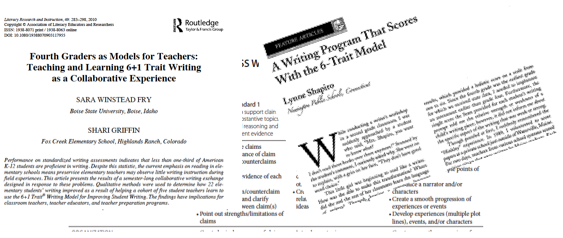 communicates what students need to do to write successfully. Writing theorists like Marzano (2004) and Northwest Regional Educational Laboratory (2008) contend that the scoring of writing should consist of: content, ideas, vocabulary, structure, voice, and conventions. The Six Traits writing model is consists of: ideas and content, organization, voice, word choice, fluency, and conventions. The +1 portion of 6+1 Trait® Writing is an add-on by Northwest Regional Educational Laboratory that provides for a specific rubric (see the Course Objectives | Research | Materials folder).
Organization looks like this: The writing is effective effective in getting ideas across with a sequencing and structure that flows to and from the topic; writing is easy to follow. A well organized writing piece invites the reader in, and keeps the reader there with a sense of interest and satisfaction of resolution or closure. Eventually, students will develop their organization to become smooth and skillfully effective with transitions that work to keep sentences, paragraphs and ideas unified in meaning. All the details fit together in a well organized writing piece. Here are some other characteristics of good organization:
- Details fit where they belong
- An inviting lead that "grabs" the reader's atatention
- A main idea supported with detail
- Clear sense of beginning, middle, and ending
- Transitions work well and ideas are connected
- A strong conclusion
- Reader doesn't have to put things together; they flow!
- Organization flows smoothly
Remember, voice is the personal tone and flavor of the writing piece; it is the song that sings into the ear of readers. Effective voice brings readers closer and distances them as needed through creative voice, strong narration, and use of lively and interesting details. Effective voice also aligns a genre to the voice, with academic tone set for how-to's and more technical pieces, and a lighter, creative more colorful tone for stories and poems. Writers must have a strong sense of audience to effectuate a strong writer's voice and communicate a strong message. Readers feel a sense of interaction with such a voice. When topics come alive as a result of effective voice, this is also what happens:
- Reader feels an interaction with the writer
- Paper is honest, sincere
- Writing is natural and compelling
- Tone is appropriate and consistently controlled
- Writer’s enthusiasm is evident
Word Choice: good writing that is pleasureable to read is rife with the right word choice - accurate, strong, specific words with powerful choice of words that energize the reader and strengthen the writing with visuals. Fresh, original expressions replace cliches, and slang, if used at all, is purposeful and effective within its context. In younger writers, we want them to experiment with new vocabulary, but use it in the proper context, taking risks that result in striking but varied vocabulary use that is natural but not overdone or trying too hard to use new words. Tell students to use ordinary words, in an unusual or inordinary way - that's good writing.
Words that evoke strong images from use of figurative language have the following characteristics:
- Words are specific, accurate, and suited to the subject
- Words are lively, powerful
- Vocabulary is appropriate for the purpose and audience
- Figurative language is used when appropriate
Sentence fluency is the rhythm and flow of a writing piece. Without fluid sentences that flow, a reader will not want to finish, because the writing will seem choppy and confusing. Fluent writing has a natural flow and sound; it glides along with one sentence flowing effortlessly into the next through varied structure, length, and with ideas that build interest one on top of another. A reader won't want to put down a fluid writing piece, because meaning is enhanced with key ideas that sync with one another. It is never too soon to teach this to students either. Teaching them how to vary sentence length, how to use patterns, incorporate rhyme an rhythm into their writing with strong control over features will teach them how.
Other characteristics of sentence fluency:
- Sentence structure clearly conveys meaning
- Writing sounds natural and fluent
- Sentences are appropriately concise
- Sentences vary in structure and length
Conventions are the mechanical correctness of a writing piece that polish off the communication and transaction that needs to happen between writer and reader. It is an important trait in communicating command of grade-level conventions, control and manipulation of language that results in stylistic effect. Strong, effective use of punctuation that smoothly guides the reader through the text, correct spelling of even the more difficult words, paragraphing that that reinforces structure, and grammar and usage that contribute to clarity and style are all characteristic of conventions that result contribute to polished writing.
Along with skill in using a wide range of conventions in longer or shorter writing pieces, complex and simple, are the following expectations:
- Grammar is appropriate
- Punctuation is appropriate
- Spelling is correct
- Usage is correct
- Paragraphing is appropriate