Structured Discussions: Best Practices
insert
2. Oral Language Development: Beginning and Intermediate
As soon as a second language learner becomes exposed to a new language, learning begins, with comprehension developing as a result of exposure and opportunities for social interaction. This results in  what is called "comprehensible input". Although it is important not to force beginners to speak, the fact is that shortly within perhaps a week to a few months, most will begin to speak on their own, and they'll want to. At this point, speech is likely limited to simple phrases and expressions with highly functional payoffs such as , "OK, "No, "I wanna play<" or "I wanna go..." as they develop, they become more capable and generate utterances according to simple grammatical rules.
A number of activities can support this oral language development: drama, song, riddles, jokes by working in groups, providing scaffolds for oral language performance to include rehearsal, and focusing students on engaging use of oral language. Engaging them through fun activities reduces the anxiety often encountered with using a non-native language.
Beginning ELLs
- Assign the ELL student to a buddy or a home group, preferably with at least one who speaks the child's home language.
- Have the buddy accompany the ELL student throughout the school day - bathroom, cafeteria, bus stop.
- Allow the home group to assume responsibility for the new child during routine classroom procedures and activities.
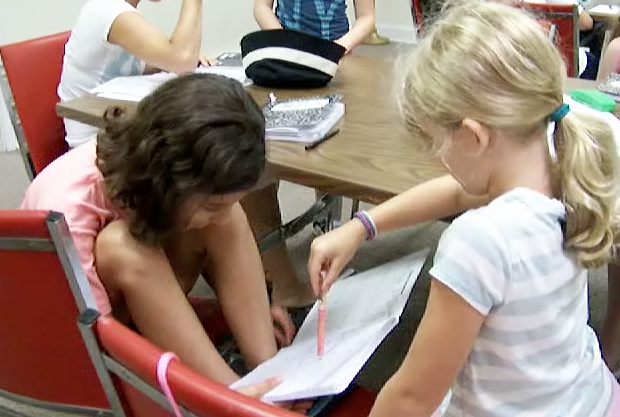
- Set up home groups of 4 to 5 students each at the beginning of the school year.
- Provide tasks that do not require speech but rather invite a nonverbal participatory response. For example, if the group is working on a thematic project, the new student may be involved in drawing, painting, coloring.
- Make use of sheltering techniques such as gestures, paraphrasing, and constant checks for understanding to aid in understanding for the student.
- Make sure small group activities happen frequently to create numerous opportunities for social interaction. With this kind of support beginners will gradually advance toward the intermediate phrase.
Intermediate ELLs
Intermediate ELLs can understand and speak English in face-to-face interactions, can speak with minimal hesitation, and have relatively few misunderstandings. Grammatical abilities such as in syntax, semantics, and phonology are still developing at this stage however. For example, students may at times confuse "he" with "she". Or conjugating verbs conventionally will get confused, like "My friend, she like to read a lot of books," using "like" instead of "likes." While teachers may want to correct, it is best to avoid correction at this stage, allowing the natural tendency of correction to take a back seat to allowing the child to do it with new language abilities. The following is recommended:
- Make a point of noticing how much the child can now do with the new language
- Show interest by asking questions that focus on the activity at hand, encouraging the student to tell you more
- Build in and model appropriate grammar and vocabulary as you respond, thereby providing input that is tailored to the students' immediate linguistic needs and interests.
- Continue with the sheltering techniques and small group collaboration
- involve students more in linguistically demanding tasks that allow them to speak out stories, mime, use the readers' theater technique, or engage in other formal language activities that permit rehearsal.
- Facilitate small group discussions of stories, science experiments, and other activities.
- Continue to accompany words and instruction with the support of charts, graphs, concrete objects and pictures to convey meaning, despite that they may seem to be speaking fluently as it will continue to reinforce.
Other activities that support language acquisition in social contexts:
- Games: simulation, drama, pronunciation games
- Songs: sing a song a day, singing out instructions, writing and singing lyrics
- Drama: acting out stories and events in any content area, thematic read alouds, readers theatre, reading poetry
- Dramatizing poetry: mini-dramas, expressive reads, reading their own written poetry, or reading the poetry of others
- Show and Tell: bring a favorite object to school, tell the class about it, show off projects, discuss readings, extra curricular activities.
- One Looks, One Doesn't: place a transparency of a picture on an overhead or flash up on a Smartboard. Tell students to view it while others look away. The students who viewed then describe it to a partner, who draws a picture of it. While one draws, the other assists to more precisely accurate what was viewed.
- Taped recordings of children's wordless book stories
- Choral reading: select age and grade appropriate materials slightly beyond what the students can read on their own. Read to the students several times while showing the words to a poem or story. Students practice through repeated readings before they perform, also brainstorming ways to act out or pantomime.
- Riddles and jokes: grade, age, and culturally-relevant and appropriate riddles and jokes are an effective way of engaging students with various backgrounds to effectuate understanding of humor and enhance comprehension overall.
References:
Abedi, J. (Ed.). (2007). English language proficiency assessment in the nation: Current status and future practice (Report). Davis, CA: University of California. Retrieved May 7, 2010, from http://education.ucdavis.edu/research/elp_report.pdf
Ariza, E. N. (2010). Not for ESOL Teachers: What Every Classroom Teacher Should Know About Linguistically, Culturally, and Ethnically Diverse Students. New York, NY: Allyn & Bacon/Pearson Education.
Yang, M., Badger, R., & Yu, Z. (2006). A comparative study of peer and teacher feedback in a Chinese EFL writing class. Journal of Second Language Writing, 15(3), 179-200.