Ell Instruction in All Content Areas
| Site: | Literacy Solutions On-Demand Courses |
| Course: | Methods of Instruction for ELLs, Grades K-12 - No. ELL-ED-112 |
| Book: | Ell Instruction in All Content Areas |
| Printed by: | Guest user |
| Date: | Wednesday, July 15, 2026, 3:51 AM |
Description
no insert
1. Literacy In All Content Areas
Literacy In All Content Areas: It's Everyone's Business!
With the Common Core Standards comes a new awareness of literacy, and new expectations with terms like technical literacy, content literacy, writing literacy, multiple literacies, critical literacy. The definition of literacy is, “The quality or state of being literate; the ability to read and write” (Webster's Dictionary, 2013). Preface that with any of the above, including content literacy, and it changes inflection to become an action rather than a skill-set, or ability. Literacy then becomes a “form of” something…a form of writing in math (math literacy), a form of reading in science (content literacy), a form of mastery in many areas (multiple literacy), and so forth. Literacy then becomes the sub-set for a standard we hold our students up to, specific to each area of content they need to master, or that we need to teach. Here is what the Workforce Investment Act of 1998 defines literacy as: “…an individual’s ability to read, write, speak in English, compute and solve problems at levels of proficiency necessary to function on the job, in the family of the individual, and in society.”
Research continues to make strong connections between reading and writing in active engagement, student interaction, and meaningful negotiation. We know that reading and writing is, by design, built from automatic skills that include semantics, syntax, and phonics – automaticity. Textbook programs are no longer one-size fits all; we no longer use them to address all students’ needs, and therefore we differentiate. Whole-class novels are no longer the norm, and curriculum standards drive district, school, and classroom decisions. This all has all driven new and exciting trends in education, particularly in the teaching of reading and writing to adolescents. Below are some methods that support the literacy initiatives of the National Common Core. See if you can identify where they plug into in your own curriculum. We will also explore this in the activity that follows:
Comprehension strategies in the content areas require deep analysis and response to text structure
The following are strategies that support text structure:
- Writing descriptions
- Sequencing ideas
- Comparing and contrasting concepts and ideas
- Analyzing for cause and effect
- Problem-solving and solution-finding
Writing
Effective writing requires mastery on both the micro and macro level; while students must think about spelling and choosing precise words, they must also be mindful of overall organization of ideas. If the students have learned how to write in another country, they may organize their ideas differently and/or use a less direct argumentation style than is typical of the American academic context (Fox, 1994). Teachers should also be aware of the differences between the writing styles of different genres. Since learners’ expectations affect their ability to perform in English (Walqui & DeFazio, 2003), teachers should highlight their disciplines’ unique features. “For example, in American history, this might include period rhetoric and referents such as the Constitution; in science it might include the ways that conclusions are stated; and in literature, it might include the routine phrases that indicate a fairy tale is in process” (Walqui & DeFazio, 2003, p.5). For low-literacy students, teachers should begin by focusing on the meaning of the writing, then move on to mechanics as their writing progresses (Barron & DiCerbo, 2006).
The following teaching methods of writing have demonstrated positive effect sizes. They are presented in order from most to least effective.
- summarization
- collaborative writing,
- specific product goals
- word processing
- sentence combining (rather than de-contextualized grammar exercises),
- pre-writing, inquiry activities, process writing
- studying models
- writing for content area learning (Graham & Perin, 2007)
In addition, ELLs must learn explicit strategies on how to write, depending on the type of text (Calderón, 2007). Students should be exposed to the various genres of writing used in schooling such as procedural and historical recounts, reports, persuasive writing and others (Schleppegrell, 2004). Writing is essential in a reading curriculum because it doubles as an assessment of reading comprehension.
Brisk, Horan, & Macdonald (2008) recommend the rhetorical approach as an effective instructional strategy for developing ELLs’ writing skills, which consists of the following steps:
- explore a general topic;
- define the purpose and audience;
- select subtopics;
- select the genre and appropriate organizational structure;
- select information;
- order examples and details,
- write a draft;
- revise and edit; and,
- prepare a final copy (Brisk, Horan & Macdonald 2008, p. 18).
Teachers should also provide feedback and explicit grammar instruction to support ELLs’ writing, especially at the secondary level (Scarcella, OELA Summit, 2005).
These activities support text structure:
- Teach students how to identify overall text patterns – cause effect, problem-solution, compare and contrast, chronological order.
- Teach students how to identify text structures when they read them, and the value of this as an aid to understanding.
- Students must recognize words that signal shifts in text structures, such as transition words: first, next, finally, and so forth, numbers, initial capped headings, italicized print and so forth.
Teach students the specific genres across all content area, through reading or writing exposure. Students must know how to identify these genres, and how to respond to them in reading and in writing:
- Biography
- Autobiography
- Informational text
- Essay
- Memoir
- Magazine and newspaper articles (feature articles)
- Diaries
- Science experiments
- How-to and directions
- Speeches
- Hypertext
Literature as a Model for Writing in All Content Areas (Graves, 1983)
The following materials can be downloaded from the Course Objectives | Research | Materials folder housed at the beginning of the course:
- Reciprocal teaching (Brown & Palinscar,1984)
- Anticipation guides (Vacca & Vacca)
- Graphic organizers
- Teacher-made study guides
- Two-column notes
- Learning logs
- Survey, question, read, recite, review (SQ3R)
- Think-alouds
- Concept Maps/Webs (Alvermann, 1991)
- Expectation outlines (Spiegel, 1981)
- K-W-L (Ogle, 1986)
- KWHL
Always include activities that activate prior knowledge, and use this knowledge to leverage with new text, challenging text, or any gaps in concepts. Engage students in background-building activities, such as rating familiar with a topic (Knowledge Rating Charts), having class discussions, using story impressions and making predictions.
- Use graphic organizers to help students see connections.
- Assist students in making text-to-self, text-to-text, and text-to-world connections.
- Use brainstorming approaches with semantic maps and graphic organizers. Scaffold this approach to their notebook.
Teachers must teach students how to monitor their own comprehension in content area texts, and what to do when comprehension breaks down. Students must have a variety of strategies to select from, such as predicting, questioning, fix-up strategies, and making connections. The goal of strategy instruction is not only to increase comprehension, but to increase independence in content area reading. Other techniques for using content area text include:
*The following can be downloaded from the Course Objectives | Research | Materials folder housed at the beginning of the course.
- Question–answer relationships (Raphael, 1982)
- Questioning the author (Beck, McKeown, Hamilton, & Kucan, 1997)
- Socratic seminars
- ReQuest (Manzo, 1969)
- Evaluating the purpose for a writing piece, author tone, and point of view from multiple perspectives (critical literacy)
- Critically evaluating web-based sources
Multi-media Approaches to Content Area Literacy for Struggling Readers and Writers
Project Look Sharp, a media literacy project out of Ithaca College in New York State, promotes and supports media literacy through a critical literacy curriculum. They are a perfect marriage of district, state, and community interests and their design is well entrenched in curriculum-driven initiatives throughout the country. Their goals include providing strategies and resources, developed in the field with a strong efficacy base, to support teaching to a critical literacy curriculum that uses media at all grade levels. Below are some methods that work as well to differentiate, as they do to make multi-media happen without any financial prejudice:
-
- NAMLE Core Principles of Media Literacy Education in the U.S.
- 12 Basic Ways to Integrate Media Literacy and Critical Thinking into Any Curriculum
- Key Questions to Ask When Analyzing Media Messages
- Key Questions to Ask When Producing Media Messages
- 6 key Concepts in Media Analysis
- Tips for Decoding
- Examining the Credibility of Information on the Internet
- U.S. Media Timeline
2. Academic Vocabulary and Oral Language
Therefore, on a regular basis, teachers across disciplines should explicitly teach content-specific vocabulary as well as academic vocabulary that may be used across disciplines (Calderón, 2007).
Some publishers such as National Geographic provide units with coordinated books at different levels. Newsela.com is another free resource that levels current news items on-demand. Alternatively, a teacher could adapt sentences and vocabulary to the extent necessary while still being authentic to the content. Teachers should also illustrate the differences representative of writing in their subject area. For instance, writing a lab report in science requires a different format and style than a narrative essay in language arts.
Pair work is a very effective organization strategy that enables peers to assist each other (Gersten et al., 2007). For example, instead of a teacher directing students to take turns reading aloud as a class, each student has many more opportunities to practice reading when paired with a partner. In addition to dramatically increasing the practice time, paired reading improves motivation and accountability (Calderón, 2007). According to some research, students of varied language proficiencies can be grouped together (Gersten et al., 2007). According to other researchers, students should be paired carefully so that high and low level English students are not paired together. Rather, teachers should pair high level students with medium level students or medium level students with low level students (Kinsella, 2008). In addition to collaborating with classmates, students should have the opportunity for independent practice, processing, and reflection on their own learning.
Academic Vocabulary and Oral Language
Gersten et al. (2007) recommend that teachers develop students’ academic language to promote their success in literacy and English language acquisition. “Academic language refers to the decontextualized, cognitively challenging language used not only in school, but also in business, politics, science, and journalism, and so forth. In the classroom, it means the ability to understand story problems, write book reports, and read complex ... texts” (Crawford & Krashen, 2007, p. 17). In writing, academic language is necessary to be able to construct topic sentences, use transitions effectively, and edit (Gersten et al, 2007). Furthermore, academic language acquisition involves more than just the understanding of content area vocabulary. It includes cognitively challenging skills such as explaining, comparing, contrasting, classifying, reporting, synthesizing, evaluating, and inferring. Academic language tasks occur in a context different from students’ familial context, especially as grade level increases. According to Verplaetse and Migliacci, “Academic language as compared to social, interpersonal language treats the speaker and receiver as if they are distanced from one another; it has been called the language of strangers ... It assumes a lack of shared history, it limits opportunities for negotiation of meaning, and it uses words rather than visuals to convey most of its meaning” (2008, p. 128). To further complicate matters, new ideas and concepts are presented to the students through the decontextualized language.
One way to help students access academic vocabulary is to teach strategies such as guessing a word’s meaning from the context or using word prefixes, roots, and suffixes to help arrive at a word’s meaning (Nation & Waring, 1997).
To assist students in expressing themselves in an academic context, the teachers can provide sentence starters that incorporate academic vocabulary. The sentence starters should be used for writing and also for oral language, to provide multiple opportunities for reinforcing the new vocabulary (Kinsella, 2008). In addition, teachers should model grammatical structures that allow students to complete the sentence starters appropriately. If the teachers have knowledge of grammar, they can explain the form required. For example, in a sentence that starts, “To combat global warming, the President should…,” a teacher can point out that the verb the students should use needs to be in the base or infinitive form without “to”. The students will benefit from instruction in the following academic language tasks: expressing an opinion, asking for clarification, soliciting a response, reporting a group’s or partner’s idea, disagreeing, affirming, predicting, paraphrasing, acknowledging ideas, offering a suggestion, or holding the floor (Kinsella, 2008). Students’ ability to acquire and use academic vocabulary will directly affect their success in expressing themselves and accessing and analyzing text. Other options include creating a “shared history” by incorporating visuals, real objects, gestures, and occasions for students to clarify meaning (Verplaetse & Migliacci, 2008).
In terms of accessing teachers’ spoken academic language, the research is divided. Some researchers support teachers making content comprehensible by speaking at a slower pace or with exaggerated enunciation (Reyes & Vallone, 2008). In addition, they suggest that teachers adjust their spoken language by  using simpler vocabulary words or grammatically uncomplicated sentences that match or are slightly higher than students’ ability to comprehend oral language (Reyes & Vallone, 2008). Other teacher educators recommend that teachers should maintain an authentic pace and tone, but increase the number of pauses in their spoken language to allow time for comprehension (Verplaetse & Migliacci, 2008). At the same time, other researchers believe that simplifying or otherwise adapting language provides inadequate input for ELLs (Walqui & DeFazio, 2003). Gersten et al. agree, stating, “the problem with regularly giving English learners a diet of familiar reading material is that the academic texts of assessments and most content areas remain unfamiliar” (2007, p. 19).
Teachers should explain to their students that native language(s) can be used in the classroom. For example, students might use their native languages to demonstrate what they know. If the teacher doesn’t speak the student’s language, often there is another student from the same language background who may be able to translate.
In order for vocabulary instruction to be effective, words should be taught in context with sufficient time for rehearsal. A student is much less likely to remember a list of arbitrary vocabulary words than words that are taken from a chapter that they are reading, writing about and discussing in class. In learning a new word, a student must hear it, say it, be able to use it in a sentence, and notice something about it (i.e., prefix,  cognate, part of speech, etc.). Repetition is essential, but always should be contextualized in meaningful ways. Because these words are pulled from the current unit, they will tend to be recycled and repeated naturally.
Most content teachers will be teaching advanced words, which are often concepts that are bolded in a textbook and link directly to the content standard (i.e., mitosis). However, ELLs often cannot access the content words because they need explicit instruction in other vocabulary. What further complicates the issue is that the supporting words often have homophones or different meanings across disciplines (Calderón, 2007). For example, consider the meaning of radical in math versus history or knowing the word sign and being confused when hearing sine in math class.
Ballantyne, K.G., Sanderman, A.R., Levy, J. (2008). Educating English language learners: Building teacher capacity. Washington, DC: National Clearinghouse for English Language Acquisition. Available at http://www.ncela.gwu.edu/practice/mainstream_teachers.htm.
3. Writing in Social Studies
Social Studies
Standards for teachers of social studies are maintained by the National Council for the Social Studies (NCSS, 2000). These standards do not explicitly reference English language learners, but they do charge social studies teachers with a responsibility to diverse learners:
Vocabulary
Since Social Studies involves a lot of reading and writing, teachers should pay particular attention to pre-teaching vocabulary words with ELLs in mind. The selected words should be a combination of content words (the words typically bolded in a textbook) and other “access” words essential to grasping the meaning. For example, Calderón (2007) describes a lesson on trading and bartering skits in which the following vocabulary is pre-taught:
|
Access Words |
|
Content Words |
|
|
coin societies ancient bronze statue |
tool dye worth merchant doubtfulness |
barter economy trade colony cultural |
diffusion Lydians Phoenicians goods |
Accessing Content

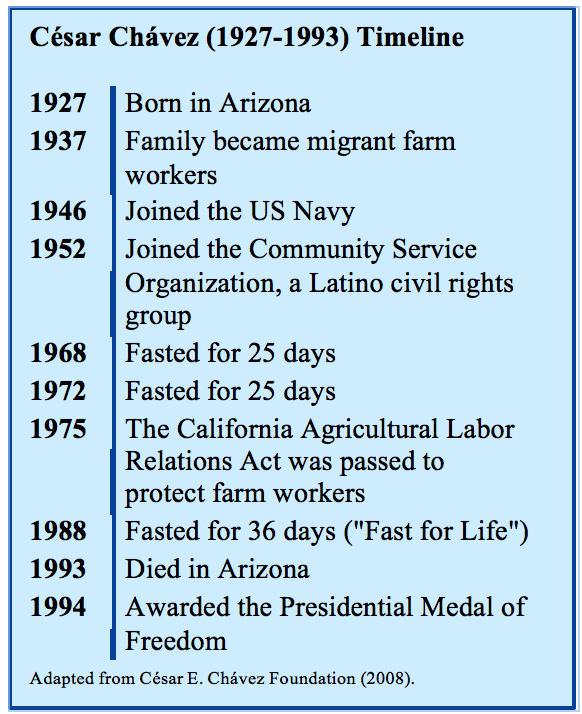
Teachers can provide a pre-reading handout with key words, events, and dates that are extracted from the textbook. At right is an example timeline on the life of the Mexican American activist and leader of the United Farm Workers, César Chávez.
Often, the Internet is a resource for integrated graphic organizers, multi-media and content. For an example with animated maps, see the multimedia tutorial “European Voyages of Exploration” from the Applied History Group in the resources section that follows.
Another strategy that is particularly helpful for students with diverse cultural and education backgrounds is the Know-Want to Know-Learn (K-W-H-L) chart. This allows teachers to informally assess what background knowledge students have on a particular topic, and then adapt their
instruction to fill in the gaps. The following is an example that could be used in conjunction with studying César Chávez:
Once the students have completed the pre-reading activities, they need instruction in the metacognitive skills of reading. To teach these, the teacher can do a think-aloud to model asking questions, making judgments, and noting new words while reading.
Inquiry-based Projects
Another option besides scaffolding the text is to lead an inquiry-based project in which students act as historians or social scientists. If ELLs are literate in their native languages, they can complete Internet resear
ch in those languages. To encourage active participation, students should be able to choose their own topics within a common category. Choice enables students to draw on their own background knowledge and sociocultural identity, and familiarity with common themes or information will assist in understanding the material in English. In this way, ELLs are viewed as cultural resources that enrich the classroom experience for other students.
To learn more about teaching Social Studies to ELLs: Web Resources
Anstrom, K. (August 1998). Preparing secondary education teachers to work with English language learners: Social Studies). NCBE Resource Collection Series, 10. Retrieved December 17, 2007 from http://www.ncela.gwu.edu/pubs/resource/ells/language.htm
Irvin, J. (2002). Reading strategies for the social studies classroom. Austin, TX: Holt, Rinehart and Winston. Retrieved December 30, 2007 from http://go.hrw.com/hrw.nd/gohrw_rls1/pKeywordResults?ST2Strategies
National Clearinghouse for English Language Acquisition. (2002). In the classroom: A toolkit for effective instruction of English language learners. Retrieved May 5, 2008 from http://www.ncela.gwu.edu/practice/itc/lessons/sinquiryss.html
The Applied History Research Group. (1997). The European Voyages of Exploration. Retrieved May 7, 2008 from http://www.ucalgary.ca/applied_history/tutor/eurvoya/vasco.html
The César E. Chávez Foundation. (2008). American Hero. Retrieved May 13, 2008 from http://www.chavezfoundation.org/_page.php?code=001001000000000&page_ttl=Americ an+Hero&kind=1
Calderón, M. (2007). Teaching reading to English language learners grades 6-12: A framework for improving achievement in the content areas. Thousand Oaks, CA: Corwin Press.
Faltis, C.J. & Coulter, C.A. (2008). Teaching English learners and immigrant students in secondary schools. Upper Saddle River, NJ: Pearson Education.
Irwin-DeVitis, L, Bromley, K., and Modlo, M. (1999). 50 graphic organizers for reading, writing, and more. (1999). Scholastic Professional Books.
King, M., Fagan, B., Bratt, T. & Baer, R. (1992). Social Studies instruction. In P.A. Richard- Amato & M.A. Snow (Eds.) The multicultural classroom: Readings for content-area teachers (pp 287-299). Reading, MA: Addison-Wesley.
McKeown & Beck (1994). Making sense of accounts in history: Why young students don’t and how they might. In G. Leinhardt, I. Beck & C. Stainton (Eds.) Teaching and learning in history.
Verplaetse, L.S. & Migliacci, N. (2008). Making mainstream content comprehensible through sheltered instruction in L.S. Verplaetse & N. Migliacci (Eds.) Inclusive pedagogy for English language learners. New York: Lawrence Erlbaum Associates
4. Science
Science

Vocabulary
Both fluent English speakers and English language learners will encounter new and unfamiliar vocabulary as they move through their science education. Unlike their English speaking peers, however, English learners are also constantly learning vocabulary in all of their school subjects as well as in their daily lives. There are a number of ways in which teachers can make the massive vocabulary-learning process required of English learners. Both fluent English speakers and English language learners will encounter new and unfamiliar words.
- Use classroom routines to present vocabulary. You might spend two or three minutes at the beginning of a class highlighting scientific vocabulary that students will need in the class. Use the same type of language each time—for instance “Here are some key words.” By making the presentation of vocabulary a routine event, students are not faced with the extra task of working out what kind of instruction is going on.
- Exploit cognates. Cognates are words which sound similar across languages because they have common origins. Much of the scientific vocabulary of English comes from words with Latin origins (like experiment, observe, precipitation); these words are likely to have cognates in languages descended from Latin (including Spanish, French, and Portuguese).
Talking Science
Communication is a vital part of the scientific discovery process. Students working in small hands-on groups in the science classroom use back-and-forth communication to make meaning out of their observations and discoveries. Teachers should ensure that English language learners are not excluded from this crucial learning experience.
- Make sure that instructions are clear to everyone in the group, perhaps by providing them in written as well as oral form, so that ELLs have time to digest the content.
- Allow speakers of the same language to work together and to discuss scientific concepts in their native language before they communicate them in English.
- If groups are multilingual, teachers can assign roles to each member of the group, and construct roles with more or greater linguistic demands to suit their diverse students. For instance, a student with limited English might be assigned to connect key concepts to new vocabulary; a more proficient student might be responsible for taking observation notes.
- When calling on students, give them a moment or two to jot down ideas before they speak in front of the class. This allows students to marshall their thoughts and gives them time to think about the language that they will need to express their ideas.
Writing in Science
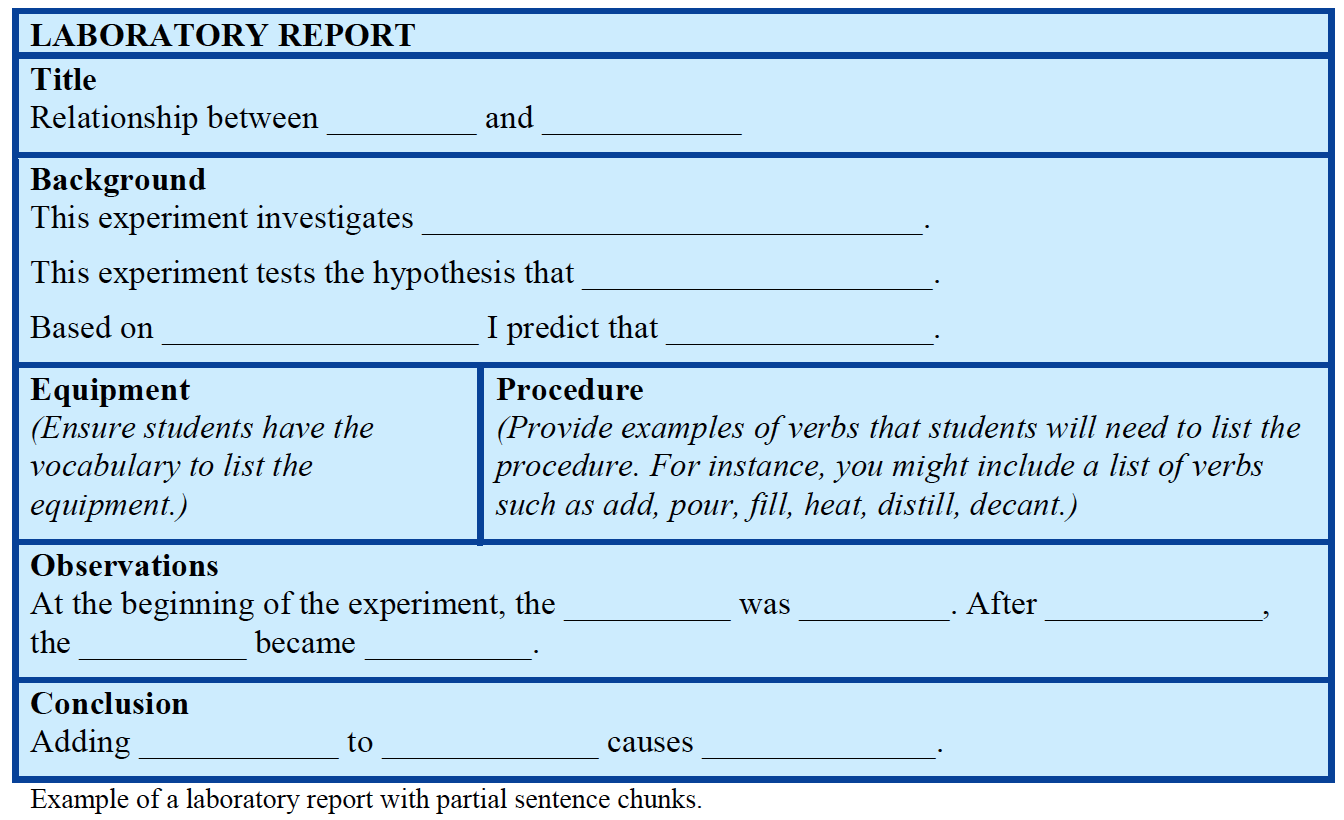
English language learners may understand the concepts of science very well, but unless they have the tools to communicate their understanding, teachers have no way of assessing their comprehension (and may underestimate it). Teachers can help ELLs by providing varying degrees of scaffolding. Of particular use to ELLs are partial “sentence chunks” that scaffold the types of sentences students should use to communicate their scientific knowledge. Sentence chunks allow students to express their scientific learning without being hindered by lack of language skills—they also model the types of scientific language students can use in the future. As students become more proficient, less scaffolding is required.
Instructional Congruence
Instructional congruence refers to “the process of merging academic disciplines with students’ linguistic and cultural experiences to make the academic content accessible, meaningful, and relevant for all students” (Lee, 2004, p. 72). Instructional congruence can refer to both ways of talking and thinking about scientific inquiry as well as ways of presenting scientific topics.
Students from diverse cultural backgrounds may have ways of approaching inquiry that differ from Western norms. They may come from cultures where it is considered inappropriate to question authorities such as teachers and textbooks. Students from different cultural backgrounds may also differ in terms of their comfort levels with working collaboratively or individually. The presentation of topics in traditional science lessons may also miss chances to connect to students’ background knowledge.
Teachers can modify instruction so that it values students’ cultural norms while simultaneously facilitating scientific inquiry. In designing a unit on weather for a multi-year professional development program, a research team built elements into the unit designed to be convergent with students’ learning. In this case, the students were mostly Hispanic students from the Caribbean and Central and South America.
The unit:
- used both metric and traditional units of measure;
- incorporated weather conditions familiar to students, such as hurricanes and other tropical weather patterns;
- used inexpensive household supplies for hands-on activities so that students could replicate the activities at home with their families;
- allowed students to work collaboratively or individually depending on their comfort level with these patterns;
- integrated science standards with both TESOL and English language arts standards to encourage English language development in social settings, in the academic content, and in socially and culturally appropriate ways.
Web Resources
Anstrom, K. (1998). Preparing secondary education teachers to work with English language learners: Science. NCBE Resource Collection Series, No. 11. Available from http://www.ncela.gwu.edu/pubs/resource/ells/science.htm
Dobb, F. (2004). Essential elements of effective science instruction for English learners. Los Angeles, CA: California Science Project. Available from http://csmp.ucop.edu/downloads/csp/essential_elements_2.pdf
Gomez, K. & Madda, C. (1995). Vocabulary Instruction for ELL Latino Students in the Middle School Science Classroom. Voices from the Middle, 13(1), 42-47. Available from http://elearning.ncte.org/section/content/Default.asp?WCI=pgDisplay&WCU=CRSCNT
&ENTRY_ID=B1585EDDA5D74E0381945A054587AC58
Jarrett, D. (1999). The inclusive classroom: Teaching mathematics and science to English language learners. Portland, OR: Northwest Regional Educational Laboratory. Available from http://www.nwrel.org/msec/images/resources/justgood/11.99.pdf
Print Resources
Carr, J., Sexton, U., & Lagunoff, R. (2006). Making Science Accessible to English Learners: A Guidebook for Teachers. San Francisco, CA: WestEd.
Fathman, A.K. & Crowther, D.T. (2006). Science for English language learners: K–12 classroom strategies. Arlington, VA: National Science Teachers’ Association Press.
The weather unit described above is taken from Lee, O. (2004). Teacher change in beliefs and practices in science and literacy instruction with English language learners. Journal of Research in Science Teaching, 41(1), 65-93.
5. Math
Mathematics

Math Vocabulary
Words which have different meanings in different contexts can be stumbling blocks for ELLs. Math vocabulary often uses words with everyday meanings which have very specific meanings in mathematics—words like product, root, function or right, as in right angle. Teachers can help students by pointing out that some words have specific meanings in mathematics, and when possible, trying to show how their 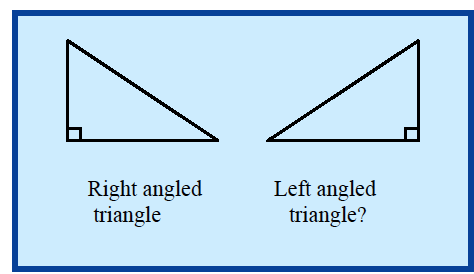 mathematical meaning connects with their everyday meaning.
One way to give students a boost in their math vocabulary is to be aware of cognates—words which sound the same across languages because they have a common origin.
English-Spanish Cognates
|
equal |
igual |
angle |
el ángulo |
capacity |
la capacidad |
|
diameter |
el diámetro |
triangle |
el triángulo |
probability |
la probabilidad |
|
estimate |
estimar |
rectangle |
el rectángulo |
|
|
Beware! Not all similar-sounding words have similar meanings. Sometimes the meaning of a word in another language may not be a perfect match for its English cognate. The Spanish la figura, for example, means “figure” in the sense of a table or graph, but does not refer to a numeral (as in a figure 8).
Sentence Structure in Math
Even simple word problems in mathematics can be difficult for English language learners because they require students to use language to understand the relationships between mathematical operators and numbers. There may be several ways to express a mathematical operation in a word problem. For instance, a problem involving subtraction might use “minus” or “less than”; one involving division may use the terms “divided by”, “into,” or “over.”
Furthermore, choosing a particular word changes the relationships between the other words in the sentence. A problem that uses the word “minus” tells readers or listeners that they should take the first number and subtract the second number. In a “minus” problem, the order of the words in the sentence is the same as the order of the terms in the operation:
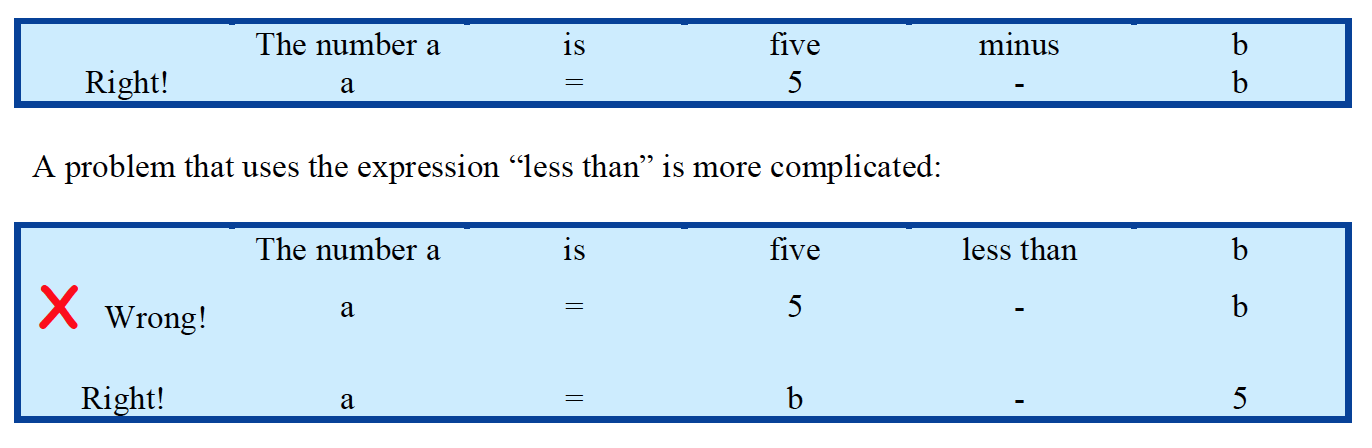
Because a “less than” sentence is more complex, students may require explicit instruction and practice with this kind of sentence. Although this subtraction example is relatively simple, good math teachers are alert for similar patterns in more complex word problems. Particularly in assessments, unfamiliar word pattern problems may end up testing students’ language ability, not what they know and can do in mathematics.
Context
Although the specifics of vocabulary and sentence structure are important, they are not the end goal of mathematics education. Rather, they are a communicative toolkit which give students the ability to think in mathematical ways and to communicate to others their mathematical thinking.
Skilled math teachers know that it is easier to encourage mathematical thinking when math in the classroom is connected to real-world situations. Math teachers who are working in multicultural classrooms need to consider whether their “real-world” problems reflect the real worlds of their students. In what real-world situations will students need to use their mathematics knowledge?
- In Alaska, the Math in a Cultural Context curriculum contains a unit entitled Drying Salmon. In Drying Salmon, students combine indigenous knowledge of fishing practices with skills measuring, estimating, proportional thinking and algebra as part of a thematic math unit.
- “Mrs. Diamante” teaches a ninth-grade geometry class in an ethnically diverse school. About one third of her students are English language learners. Her lessons about functions and slope connect mathematical ideas to the needs of her students’ communities. Students in Mrs. Diamante’s class have used their math skills to design wheelchair ramps, skate ramps, and sloped roofs for bus shelters.
Although actual examples of ways that other teachers have adapted lessons to fit the cultural contexts of their students can be illuminating and inspiring, teachers cannot and should not take an example from one context and expect it to work in another. Every math classroom is situated within its own specific community, and each community is unique. Good math teachers will look for examples which fit their own contexts, and will work with their pedagogical content knowledge tools to adapt lessons to fit their own unique classrooms.
Web Resources
The Texas State University System Math for English Language Learners Project (http://www.tsusmell.org/) has a wealth of useful techniques and tips for math teachers.
The Connected Mathematics project at Michigan State University has a page on mathematics and English language learners at http://connectedmath.msu.edu/teaching/ell.html
Long Beach Unified Schools District (n.d.) Math cognates. Retrieved April 14, 2008 from http://www.lbschools.net/Main_Offices/Curriculum/Areas/Mathematics/XCD/ListOfMat hCognates.pdf
Southwest Educational Development Laboratory (SEDL) (2007). What can a mathematics teacher do for the English language learner? Austin, TX: Author. Available at http://txcc.sedl.org/resources/mell/index.html
Stepanek, J. (2004). From Barriers To Bridges: Diverse Languages in Mathematics and Science. Northwest Teacher, 5(1), 2–5. This resource expands on many of the themes expressed above: http://www.nwrel.org/msec/images/nwteacher/winter2004/winter2004.pdf
Print Resources
More information on the unit Drying Salmon can be found in Nelson-Barber, S. & Lipka, J. (2008). Rethinking the case for culture-based curriculum: Conditions that support improved mathematics performance in diverse classrooms. In M.E. Brisk (Ed.), Language, Culture and Community in Teacher Education (pp. 99-126). New York: Lawrence Erlbaum Associates.
“Mrs. Diamante” is a composite character described in Chapter 5 of Faltis, Christian J. & Coulter, Cathy A. (2008). Teaching English learners and immigrant students in secondary schools. Upper Saddle River, NJ: Pearson Education, Inc.
Other ideas described above are adapted from:
Anstrom, K. (1999). Preparing secondary education teachers to work with English language learners: Mathematics. NCBE resource collection series, no. 14. Retrieved February 28, 2008 from http://www.ncela.gwu.edu/pubs/resource/ells/math.htm
Dale, T. C., & Cuevas, G. J. (1987). Integrating mathematics and language learning. In J. A. Crandall (Ed.), ESL through content-area instruction: Mathematics, science, social studies (pp. 9-54). Englewood Cliffs, NJ: Prentice Hall Regents.
Secada, W. G. (Ed.) (2000). Changing the faces of mathematics: Perspectives on multiculturalism and gender equity. Reston, VA: National Council of Teachers of Mathematics.
References
Ballantyne, K.G., Sanderman, A.R., Levy, J. (2008). Educating English language learners: Building teacher capacity. Washington, DC: National Clearinghouse for English Language Acquisition. Available at http://www.ncela.gwu.edu/practice/mainstream_teachers.htm.