Social and Academic Language: Vocabulary and Reading
| Site: | Literacy Solutions On-Demand Courses |
| Course: | Methods of Instruction for ELLs, Grades K-12 - No. ELL-ED-112 |
| Book: | Social and Academic Language: Vocabulary and Reading |
| Printed by: | Guest user |
| Date: | Wednesday, July 15, 2026, 3:51 AM |
Description
insert
1. The Social and Academic Context
Social context of language consists of the setting, the speakers, and the social and power relationships among them. Language forms include choice of words, grammar, and pronunciation. The social context in which a language is used plays an important role in communication, setting parameters, formality, politeness, cultural integration, and guiding linguistic choices. The social context of language places different cognitive and social demands on speakers, which in turn affects the quality of oral language used. The same happens in a native language. For example, a casual chat with a friend about a movie will differ greatly from a chat about a formal job interview with six interviewers at the table. The old "watch what you say" plays an important and central role in clarity, precision, and grammatical correctness. For ELLs, the more formal and cognitively demanding instances can trigger notably more errors in pronunciation grammar and vocabulary than would occur in the less formal chatter. It is thus important to observe and draw qualitative conclusions about them in a variety of social and academic contexts to understand the depth and level of communication proficiency, both formal and informal.
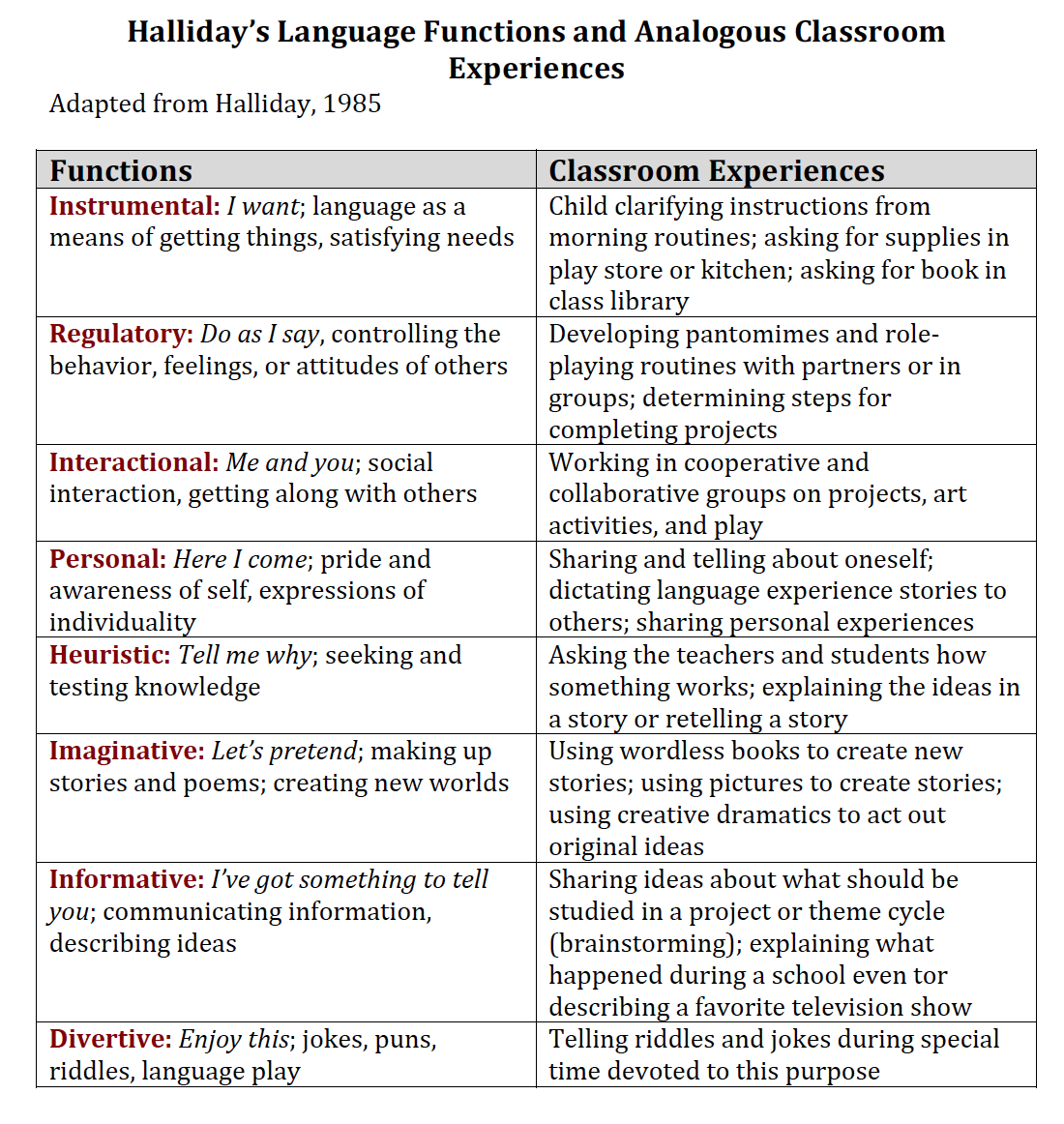
Halliday (1985) refers to language forms as "language functions", and correlates specific activities to specific communicative functions in the classroom. For example, interactional function is about getting along with others such as in cooperative group work and learning centers. Group work builds skills on all levels - reading, writing, listening, speaking, and as teachers we should help them develop each interactively using language effective for the Halliday functions.
Halliday's Language Functions and Analogous Classroom Experiences
2. Six Steps for Teaching Academic Vocabulary
Research continues to show that students comprehend better with vocabulary instruction than without it (Marzano, 2010). Building background knowledge is as crucial to this as is the direct instruction of vocabulary, and is more important than IQ when it comes to understanding  reading. Content area vocabulary instruction has shown to be highly effective in helping students to understand content area vocabulary concepts, particularly in mathematics (Marzano, 2010). And yes – direct instruction makes a difference.
Here are some suggestions for teaching academic vocabulary:
- Decide on number of words to be taught directly at each grade level (K-2, 3-5, 6-8,or 9-12). Suggestion:150 vocabulary words per year or one word weekly for each academic subject.
- Ask yourself when deciding which words or terms to teach: Is this term critically important to content I will be teaching this year? If the answer is “yes,” then teach it!
- Rule of Thumb: If terms you want to teach are not found in the appendix, add them to the list.
- If your selection of words or terms total more than the original number you planned for, revise because less is more when it comes to retention.
- Use student vocabulary notebook from one year to the next. Application of a word one year may take on a different application the next.
Marzano & Pickering (2005) propose a six-step process to directly teach words crucial for the acquisition of new content learning. They are as follows:
Step 1: Provide a description, explanation, or example of the new term.
While word definitions have their reference place as an instructional and learning tool, they are not as useful as the more prepatory aspects of learning new vocabulary, such as predictions using semantic features of the word (word beginning, root words, prefixes and suffixes).
ELL students will benefit from additional description and explanation, along with a visual representation of the word.
Step 2: Ask students to restate the description, explanation, or example in their own words.
Word descriptions are not as comprehensive, or as accurate, as a vocabulary solution, but they are a good place to begin when students need to acquisition to new understanding of a word or term. The goal is to have students retain the definition in long-term memory, versus spell out a specific recitation on-demand. Processing this information repeatedly will help achieve long-term retention. Moving from basic description to explanation and example in their own words will go much farther than a definition and description by itself.
ELL students can restate the description multiple times, along with the explanation in their native language.
Step 3: Ask students to construct a picture, symbol, or graphic representation of the term or phrase.
Modeling this procedure and process is crucial. First have students work together in peers or small groups to process their thinking and collaboratively construct a graphic representation by drawing or overdrawing the word. This step is most effective immediately after Step 2.
ELL students can draw a pictorial representation of the term or phrase, or copy the teacher’s from Step 1.
Step 4: Engage students periodically in activities that help them add to their knowledge of the terms in their notebooks.
With multiple word or term exposure, students can interact with a new vocabulary word repeatedly, and this will lead to mastery. Revisiting the new insights gained from and through this repeated use and exposure by writing in their notebooks will help to cement learning, moving the abstract to the concrete.
- Ex. “Remember capitol, with an O, always refers to a building.
- If reviewing “symbiosis,” they might add, “related words: “ mutualism and parasitism.” If re-examining the math term “addition,” they might write, “Antonym-subtraction.”
Allow ELL students to use their native language when reporting insights in their notebooks.
Step 5: Periodically ask students to discuss the terms with one another.
Peer-to-peer interaction plays a key role in development of academic vocabulary. Facilitating discussions using terms of their own words and in their own language will offer them multiple perspectives, self-expression, acquisition of more insight and understanding of key academic vocabulary. In addition, it will increase the probability that the information will be stored in permanent memory. When students were called on without expecting to be called on in vocabulary instruction, they recalled less words than those who were prepared to be called upon (Stahl & Clark, 1987) – call on students equally for academic equity!
Ell students would benefit from discussion with peers, using strategic pairing, about words.
Step 6: Involve students periodically in games that allow them to play with terms.
Challenging students with games contextualizes learning while providing more opportunities for multiple vocabulary exposure through context – thus cementing words and terms into long term memory. In addition, games create rife conditions for more inquiry, student engagement, and with outcomes that can allow for more risk-taking than a classroom might provide.
- See Marzano and Christensen’s book Literacy Plus: Games for Vocabulary and Spelling they described in depth how teachers might use games in vocabulary instruction.
In General:
- Target 1 to 3 new terms per week for 30 weeks to teach and lead to mastery of new academic vocabulary and terms.
- Set aside periodic and consistent time to engage students in vocabulary activities and games.
- Set aside ample and consistent time for vocabulary discussions among students.
- Use vocabulary notebooks: require students to keep and add information them.
