Theories of Language Acquisition and Differentiation for ELLs
| Site: | Literacy Solutions On-Demand Courses |
| Course: | Methods of Instruction for ELLs, Grades K-12 - No. ELL-ED-112 |
| Book: | Theories of Language Acquisition and Differentiation for ELLs |
| Printed by: | Guest user |
| Date: | Wednesday, July 15, 2026, 4:35 AM |
Description
x
1. Language Acquisition Theories
We’ll discuss three language theories in this module:
- Behaviorist
- Nativist
- Social Interactionist
- Brain-Based Theories
Behaviorist theory says that children acquire a first language by listening and repeating what adults, or native speakers, say (Skinner, 1957). Where behavior is learned by imitation, culture determines their beliefs. While the latter is true, the former is often under question by other theorists because the behaviorist theory of “imitation” does not account for creative uses of language the children often engage in, such as utterances, made up words, and replacement words (Whelan Aniza, 2010).
Nativist theory, pioneered largely by Norman Chomsky (1979), asserts that children are born with an innate language learning capacity” referred to as the Language Acquisition Device or LAD. Chomsky claimed that students are born with innate structures and a propensity for language and the rules of grammar, regardless of what language they are born into. They often correct themselves in both of these theories. Compare the two theories below:
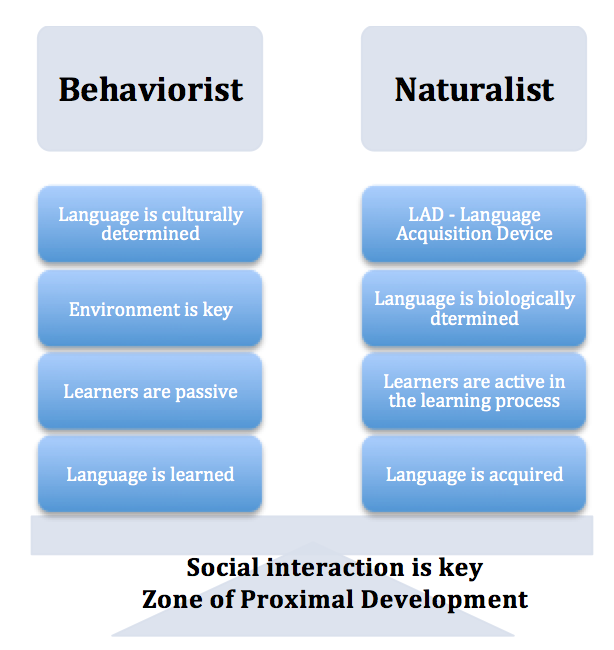
Adapted from Ariza, 2002.
While the acquisition of language varies from one child to another, the stages in which the skills develop are highly predictable, and hinge greatly on one’s immediate environment: at home, in school, in the community (social).
Social Interactionist Theory assumes that a child’s development linguistically is shaped by his or her environment. Speech for example, can promote meaning negotiation through interaction between a parent and a child. Using the language promotes meaning. Lev Vygotsky (1962, 1978) calls this the “Zone of Proximal Development.” The Zone of Proximal Development assumes that students can achieve anything independently that they can receive help on with the right scaffolds that move them from actual development to potential development. Under this theory, students are provided with strategies and materials that target their developmental areas specifically. For example, when a child says, “I see the new baby, Mama!” The parent expands on the statement with, “Yes, how much as she grown? What color is her hair?”
Brain-Based Theory asserts that learning a new language, or a language for the first time, is a complex process that involves multiple cognitive functions, in addition to age motivation, comprehension, affective conditions, and how students are taught within the methods used and the pedagogy employed. Brain-based theories propose five hypotheses:
- Acquisition Versus Learning
- Natural Order
- Monitor
- Affective Filter
- Input
This theory argues that comprehensible input challenges and pushes learners deeper into language proficiency, and further along on the language development continuum (Krashen, 1981). Thus, a natural approach for learning a second language with methods of teaching that provide comprehensible input for second language learners. Providing comprehensible input includes teaching that engages students’ interests, particularly for those from less literate environments. The following hypothesis are consistent with brain-based theories:
- Acquisition Versus Learning Hypothesis: Drill and practice are not natural, nor productive ways to advance students along the language continuum.
- Second language learners have a “silent stage” where they listen more than produce, and teachers should be patient and appreciate this silence as real language develops slowly, beginning with speaking (Krashen, 1982).
- Natural Order Hypothesis: Grammar should not be the focus of language arts instruction. Language acquisition evolves gradually and naturally; rules need not be formally taught.
- Input Hypothesis implies that learners must understand the language they are exposed to, and should be challenged slightly beyond their immediate level for acquisition to occur.
- Scaffolding produces comprehensible input through the use of visuals, graphic organizers, differentiated curriculum, paraphrasing, clear and slow pronunciation, buddy tutoring, and group work.
- Monitor Hypothesis is error-correction in the brain, where utterances of speech are self-edited, and therefore corrections to language by teachers and peers are not productive unless students are developmentally ready to understand and correct them. Errors are natural because the brain is designed for trial-and-error learning, and thus error correction is not natural. In fact, correcting all errors impedes a learner’s natural inclination to communicate.
- A non-threatening and safe learning environment is pivotal to the Affective Filter Hypothesis, which believes that learners need to feel secure in order to continue learning and advance academically. Topics and practices that resonate with students socially and culturally contribute to this safe environment, where collaboration without competition is encouraged. Lessening anxiety, working learning into motivation, student interest, and readiness for new challenges.
A great deal of work in the cognitive sciences now focuses on education, and reveals that both adults and children use different parts of the brain to learn a second language. Through Parallel Distributed Processing, the brain can process numerous chunks of information simultaneously, which also means that learning a second language uses the same process, and goes through the same stages, as learning a first language (Hill & Flynn, 2006). According to Hill & Flynn (2006), successful differentiation can only occur if teachers can understand their students’ stage of language acquisition.
Vocabulary key terms to become familiar with as we move forward in this course:
Morphology
Morphology is the study of word formations. Because languages vary in their word tense, words that use or denote gender, and syntax, morphology can be complicated when learning a new language. For example, in Haitian Creole the pronoun “he” can refer to a female or an inanimate object only because the pronoun “she” does not exist in that language. Also in Haitian Creole, the word “be” doesn’t exist, so “I hungry” is appropriate, where in English it would be “I am hungry.”
Syntax
Syntax is the order of words in language, or word patterns in sentences, For example, every complete sentence in the English language must consist of a subject, a verb, and an object. For example, “John has a black car” in Spanish it would be, “John has a car black”. How about this one, hinging completely on conventions:
Woman, without her, man is nothing.
Versus
Woman, without her man, is nothing.
(Whelan Ariza, 2010, p. 37).
Semantics
Semantics study word meanings and phrase meanings. Connotative meanings make sense to students with requisite cultural knowledge more so non-native speakers. Semantics include idiomatic expressions, ambiguous sentences, and relevant real-world knowledge to make meaning of words and phrases. Therefore, interpretations of words, idioms, and metaphors vary from one culture to another. Here are some examples of culturally pertinent phrases with connotative meaning:
- Getting “paid under the table.”
- “Read my lips…no new taxes.”
- I’ll give her a “piece of my mind!”
- His jokes drive me “up a wall!”
Phonology
Phonology involves the study of sound systems within a language – stress, emphasis, pitch, and sound all factor into these sound systems within language that can imply a great deal about a students language capability and degree of acquisition. Learners acquiring a new language develop accents, unless they learned the language at an early age.
Pragmatics
Pragmatics involve how and why a language is used in a certain context. For instance, formal versus informal references to people, depending upon how well you know them, and from what background you can e to know a person. “Yo” for example, is acceptable among friends in certain social circles, though not acceptable to a supervisor or someone of authority that one does not know well personally.
What does all of this have to do with differentiation for all students, in all classroom settings? Let’s keep moving to find out.
References:
Whelan Aniza, E. N. (2010). Not for ESOL Teachers: What every Classroom Teacher Needs to Know About the Linguistically, Culturally, and Ethnically Diverse Student. 2nd Ed. Allyn & Bacon: Pearson Education, Inc.
Hill, J. D., Bjork, C. (2008). Classroom Instruction That Works with English Language Learners: Facilitator’s Guide. Alexandria, VA: ASCD.
2. The Stages of Language Acquisition and Differentiation
Language Acquisition and Differentiation
Strategies and Stages
Stage 1: Pre-production Students take in the new language silently, sort of in the background to assimilate it. While they don’t speak it, they are assimilating it and this period can last for several weeks. Reinforce listening comprehension through read-alouds and songs/music. Speak slowly, use shorter words, phrases and sentences for ease and expediency of understanding. Demonstrate the meaning of new words and how to keep records of words for future use through vocabulary journals, acting out certain phrases with, “For example, watch as I…” using gestures and pointing. Model correct language use, and rather than correct simply rephrase correct use of words and phrases. Pair students up with English-speaking peers to help interpret and aid academically when possible.
Stage 2: Encourage pointing, and require repeating Small groups, or buddy groups, to have peer discussions, look up answers to questions, or write short responses and share aloud in class. Keep questions at “yes” or “no.” Encourage repeating of phrase and sentences; singing, rhyming, repetition for younger students. Continue to model correct usage of the language. Use and hold academic discussions with academic vocabulary. Teach academic vocabulary, model its use and pre-teach academic vocabulary for challenging text. Provide culturally-friendly visuals to reinforce concepts when possible.
Stage 3: Use charts and graphs to display information. Introduce graphic organizers and help students chunk information for writing, oral response, or preparing answers to questions. Have students re-tell stories or experiences Encourage home-school connections by requiring students to read aloud at home and describe events in the home language to reinforce understanding. Use fill-in-the-blanks for writing activities, cloze for vocabulary in context teaching, and chunk writing assignments requiring students to place information in categorically, pulling together later. Story maps are good examples, allowing students to think through the elements of literature, and pull them together through whole writing pieces with teacher or peer assistance. Employ think-pair-share activities to allow for processing of new language, vocabulary, and to reinforce understanding of concepts through clarification of, and discussion with, peers. Ask for clarification on responses that are not understood, allowing for sufficient wait-time. Rephrase as appropriate, and have students repeat the phrase back.
Stage 4: Ask students to agree or disagree with opinions or when discussing text. Teach, have them use, and model the use of advanced academic language that include opinion, persuasion/argument, and evidence. Teach students when and how to use formal and  informal English, and what instances are appropriate and non-appropriate Have students prepare and give presentations, interspersed with language prompts for them to complete. Use and keep visible for reference, writing and speaking prompts. Correct errors within the realm of what was taught, otherwise students can still become overwhelmed. Correct as appropriate, but not too frequently; rather, speak correctly and have them repeat. Introduce and use key words related to text, and teach academic vocabulary directly. Use graphic organizers and thinking maps.
Stage 5: Teach students to use dictionaries, pictionaries, and thesaurus independently to identify the meaning of new/unknown words. Teach students how to use context to identify the meaning of new/unknown words. Introduce and teach idioms and cognates with examples and non-examples. Introduce more corrective feedback in syntax, pragmatics, pronunciation and other language elements. Develop language goals with students. Teach etymology of words or word families. Create assessments that allow for opportunities to articulate answers in English.
Stage 6: Teach advanced vocabulary to include the use of antonyms, synonyms, advanced use of a thesaurus and dictionary. Teach effective note-taking through use of a template, such as Double-Column notes, or Frayer Notes. Other ways to differentiate include scaffolding instruction so that students are eased into challenge, and so that they lean into it, by gradually giving them more accountability and responsibility for learning. Giving them tasks at their level, while increasingly heightening the challenge of the tasks, is the way to scaffold so that they receive challenge at an appropriate pace that will expedite academic progress. Asking questions for example, would increasingly become more “what if” centered than, “what” and so forth. Rather than one-word yes or no answers, hold them to shorter more descriptive answers. Eventually, in the fluent stages, have them discuss opinions, and show evidence of their learning.
Other Differentiation Techniques
Scaffolding is about making instruction appropriate, within the students’ grasp, and meaningfully engaging. Use of cognates is another way to acclimate second language learners to the English language as they draw as much meaning from context as possible. Provide students with a list of common cognates for reference. Teachers can also point them out explicitly in every day speech, or as opportunities arise within the context of instruction.
Explicit vocabulary instruction is probably the best way we can accelerate students’ academic achievement overall, especially for ELLs. While the push of the Common Core, and many state standards that have aligned to the Common Core, is for learning in context (looking at words within words, whole sentences and paragraphs to unlock new/unknown word meanings), ELL students need focused and explicit vocabulary instruction, especially prior to reading text. Tiered Questions
Using tiered questions, or questions scaffolded by complexity (intentionally) can keep ELL students engaged as more questions are asked the build upon the former. Tiering questions is a way to achieve this. Building them into lessons by differentiating them, for example grouping students and holding them responsible for answers according to their groups. Asking questions throughout each lesson allows them to practice their thinking ahead of time, while better preparing them for assessments when they must think on their own. Tailor questions for each stage of language accordingly.
Example of Tiered Questions: Early Production: yes/no, followed by short phrases. Ask students to point to pictures, books, or objects around the room to depict response and understanding. Speech Emergence: ask questions for short response, such as short constructed response or short answer questions. A one-word response at this phase is no longer appropriate. Why and how questions are appropriate.
Intermediate and Advanced Fluency: Hold students accountable at this stage for longer and more elaborate answers in any setting: whole class, peer-to-peer, student-to-teacher, small group. What might have happened if? And, “Why did you think that?” Are good questions to ask at this stage. Advanced Fluency: Students can retell stories, events, story elements, main ideas, and even make inferences. There continues to be evidence of increased educational attainment when English fluency increases among bilingual and ELL students, particularly when differentiation is used to scaffold and increase achievement (Strand and Demie, 2005; Demie and Strand, 2006; Tomlinson, 2008).
See the Course Objectives | Research | Materials folder for tools and guides that support these strategies and techniques.
References and Other Resources:
Hill, J. D., Bjork, C. (2008). Classroom Instruction That Works with English Language Learners: Facilitator’s Guide. Alexandria, VA: ASCD. Native American Literature http://www.indigenouspeople.org/natlit/index.html
Multicultural Resources http://curry.edschool.virginia.edu/go/multicultural/
Multi-Language Activities and Projects http://www.kidlink.org/
3. The Language Experience Approach - LEA
The Language Experience Approach
On the recognition that all students bring experiences to school, and that those varied experiences must be validated to create an environment of safety, comfort, competence and confidence for students new tot he English language. To do so, the Language Experience Approach invokes thinking, speaking, listening, reading and writing while personally involving students in reading, writing, speaking, and listening. It is ideal for small group instruction.
The Language Experience Approach, or LEA, is an experiential, child-centered method of teaching that is highly effective in getting students to read, and keep reading - especially students learning a second language. As students' thoughts are valued, they're inspired to read predictable material that has roots in their own experiences, culturally and personally, as the basis for reading and for writing. Using words and with pictures they are already familiar with, this approach works into a reciprocal process of reading, speaking, listening, writing, and corresponding through social norms and the use of social vocabulary with interactions among peers.
Using social vocabularies in peer exchanges, students build upon vocabularies that are at first limited to be conversational, then after practice advance to more advanced academic vocabulary. Words and phrases from the home language may also be used and are encouraged. Children engage in "code-switching" where they move between languages drawing from their first language for the most meaning and understanding.
Let's see how it works:
- Students are told they will compose a story based on an experience they all had together.
- Teacher and students brainstorm story ideas together, which can range from a class trip, a theme of study, or another school-based experience they can all share in.
- Teacher models the story writing process first, as students dictate the story, watching the teacher write and listening to thoughts as it unfolds.

- The teacher writes visibly, such as on a Smartboard, Whiteboard, overhead projector, Elmo, chart paper, or chalkboard.
- Students observe the teacher writing. (You watch.)
- Students and teacher read the story together. (We do.)
- Students read the story on their own while the teacher listens, either one at a time, circulating among peers, or one-on-one. (You do.)
- Teacher reads the he or she wrote aloud.
- The students edit the text.
The LEA can also be used in conjunction with some fun digital technologies, such as Storybird, writing collaborative stories digitally, or using virtual field trips to create an experience to then draw upon.