Social and Academic Language: Vocabulary and Reading
1. The Social and Academic Context
Social context of language consists of the setting, the speakers, and the social and power relationships among them. Language forms include choice of words, grammar, and pronunciation. The social context in which a language is used plays an important role in communication, setting parameters, formality, politeness, cultural integration, and guiding linguistic choices. The social context of language places different cognitive and social demands on speakers, which in turn affects the quality of oral language used. The same happens in a native language. For example, a casual chat with a friend about a movie will differ greatly from a chat about a formal job interview with six interviewers at the table. The old "watch what you say" plays an important and central role in clarity, precision, and grammatical correctness. For ELLs, the more formal and cognitively demanding instances can trigger notably more errors in pronunciation grammar and vocabulary than would occur in the less formal chatter. It is thus important to observe and draw qualitative conclusions about them in a variety of social and academic contexts to understand the depth and level of communication proficiency, both formal and informal.
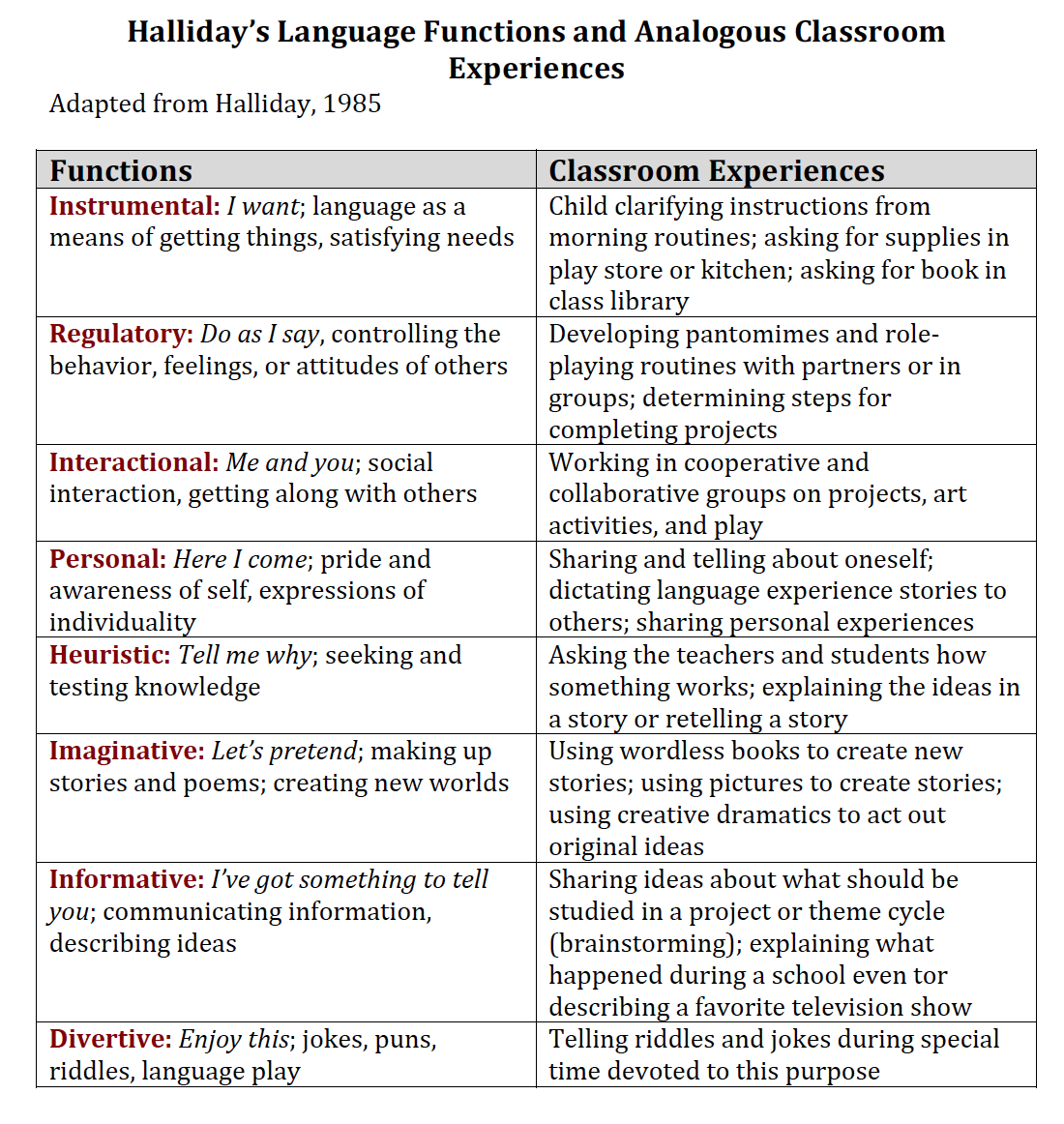
Halliday (1985) refers to language forms as "language functions", and correlates specific activities to specific communicative functions in the classroom. For example, interactional function is about getting along with others such as in cooperative group work and learning centers. Group work builds skills on all levels - reading, writing, listening, speaking, and as teachers we should help them develop each interactively using language effective for the Halliday functions.
Halliday's Language Functions and Analogous Classroom Experiences