Migration To a Standards-based Curriculum
2. 10 Steps to, and for, Alignment

10 steps that district stakeholders can, should, and have taken to achieve a proper and effective standards alignment (Achieve, 2014) include the following:
Step 1: Identify and Engage All Stakeholders
Indeed it takes a village to understand, unpack, and align a Common Core curriculum. It takes building administration to understand on a large scale the student population; it takes a central administrator to know what the resrouces are and who the players are that can contribute to their access; it takes a teacher to know and understand all components of the curriculum, and know the students as the end recipients of such curriculum. When teachers participate in the process of a standards alignment, their input is pivotal to developing strategies tnat ensure the curriculum and its delivery – including all assessments – will rise to the new expectations (Achieve, 2013).
Step 2: Perform a Gap Analysis
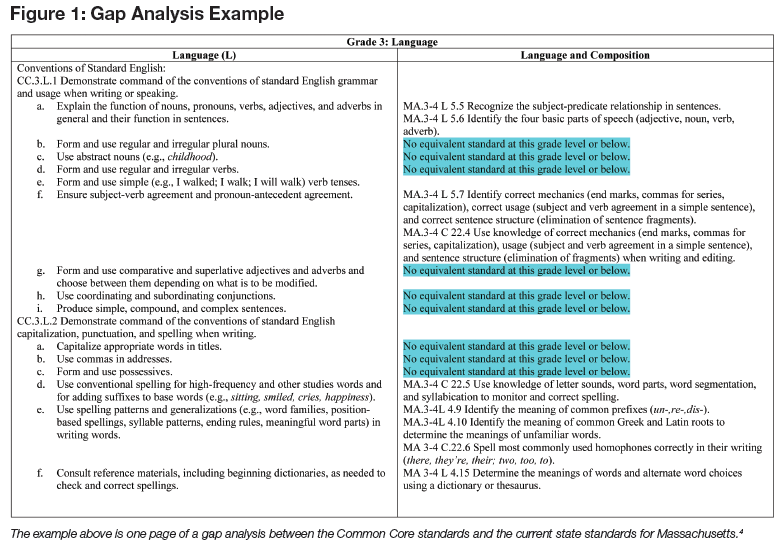
Determine how the state standards and/or the curriculum differs from the Common Core standards, and where the gaps between the two may exist. Ask the following questions: Is there a skill addressed in the state standards or within the curriculum at grade 3 that is also addressed in the CCSS standards at another grade level? Is there content in the CCSS that hasn’t been covered under the state standards or curriculum Is there content that is covered in the curriculum that is not covered in the CCSS?
Here is an example of one state’s gap analysis in aligning the CCSS to a state curriculum:
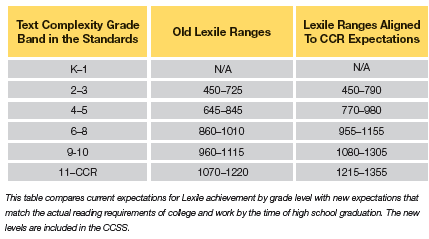
This example demonstrates how the Lexile, or reading level expectations, change with the CCSS:
Remember, the Common Core Standards require that half of student reading should be fiction and the other half non-fiction by Grade 4, and then switches to a 45/55 percent split in favor of non-fiction by grade 8, with the trend continuing until grade 12 where 70% is non-fiction. This is another gap.
Step 3: Provide and/or Partake in Professional Development
Learning how to teach to the standards, how to align them, what materials are available to support them, and how to implement the new expectations in the classroom is basic to a CCSS-aligned course of professional development; one in which teachers are fully supported, and come out with the requisite knowledge to do it justice.
Step 4: Visualize the Standards’ Full Trajectory
Look beyond the grade level you teach when considering the full range of the standards with which to align; rather, go a grade below and a grade above when determining what students should know and be able to do. Consider what students learned before, what they will be expected of them next. Vertically align them to reach across grade levels, curriculum areas, and move toward a common, central point for college and career readiness. The common progression of the standards and how they are laid out will move naturally toward this place in anchoring multiple grade levels toward what has traditionally been individual and separate within curriculum frameworks.
Step 5: Think About How Standards Cross Curricular Disciplines
Because the CCSS reach across reading, writing, speaking, listening and language, they apply to multiple content areas. Thus, any curriculum aligned to them must facilitate them materially and with ample resources to allow cross curricular transfer and access.
Step 6: Create a Repository of Lesson Plans and Other Resources
Resources and access to them are everything. In order to fully migrate to the CCSS, districts must require that teachers use new materials in new ways. Pooling knowledge, materials and resources can work to integrate and work outward from when aligning curriculum: identifying gaps, plugging gaps, making proper alignments. Providing Internet space, Intranet space forums for sharing, regular discussions of best practices and pooling of related resources will facilitate better movement toward effective teaching to the CCSS. Even a web presence such as a district or school website can go a long way in facilitating communication and intra-professional learning in support of a CCSS curriculum.
Step 7: Consider All Students’ Needs
ELLs, students with disabilities, struggling Tier II and II students must all be identified and provided for in services, accommodations, classroom support, and internal and external resources to access the Common Core resources, and to rise to their expectations. Most important: Teachers must have access to them as well. Providing students with additional time, instructional support, assessments, progress monitoring all requires an individual diagnostics with appropriately aligned instructional resources.
Step 8: Follow the Leading Assessment Consortia
PARCC, SBAC, Achieve, Common Core Toolkit – most states have aligned Common Core resources for educators, parents, and for students. PARCC offers newsletters and webinars for example. SBAC provides materials and resources for development, assessment, and timely updates.
Step 9: Provide Common Core Information in Many Formats
Internet, Intranet paper curriculum, hard copies, cds/software, live support – access, and timely access allows for communication, collaboration, and high use. It makes a difference.
Step 10: Conclusion: Step Back and Reflect
Ask yourself the following:
- Did the lesson work for the student or students? Why or why not?
- How can I further differentiate the material or curriculum?
References:
Common Core State Standards Initiative website, “About the Standards” page: http://www.corestandards.org/about-the-standards
Common Core State Standards For English Language Arts & Literacy In History/Social Studies, Science, And Technical Subjects: http://www.corestandards.org/assets/CCSSI_ELA%20Standards.pdf
The CEP report based on the survey, “Year Two of Implementing the Common Core State Standards: States’ Progress and Challenges,” examines states’ progress in transitioning to the new standards: http://www.cep-dc.org/
Comparative Analysis: The Massachusetts Curriculum Framework for English Language Arts and Literacy PreK- 12 (2011) and The Massachusetts English Language Arts Curriculum Framework (2001)
Supplement (2004), Massachusetts Department of Elementary and Secondary Education, January 2011 (page 42): http://www.doe.mass.edu/candi/commoncore/0111ELAanalysis.pdf